
Wastewater Infrastructure That Scales With Your Development
Septic tanks, soak pits and exhauster trucks cannot keep pace with the wastewater volume of a high occupancy property, and an engineered BZMBR Wastewater Treatment Plant solves this by treating that volume continuously on site, sized to the development from the start.
The problem you already know too well
You are developing or managing a property with real occupancy: an office park, a hotel, a gated estate, a campus, or an institution generating thousands of litres of wastewater every single day. A septic tank and soak pit were never designed for this volume, and exhauster trucks cannot keep up with hundreds of people using the same system daily. One missed collection, one overflow, one compliance visit from NEMA, and you are looking at fines, reputational damage, or a shut down site.
At this scale, wastewater is not a maintenance task anymore. It is infrastructure, and it needs to be engineered as such from the start.
There’s a better way: build the BZMBR Wastewater Treatment Plant into the site, not as an afterthought
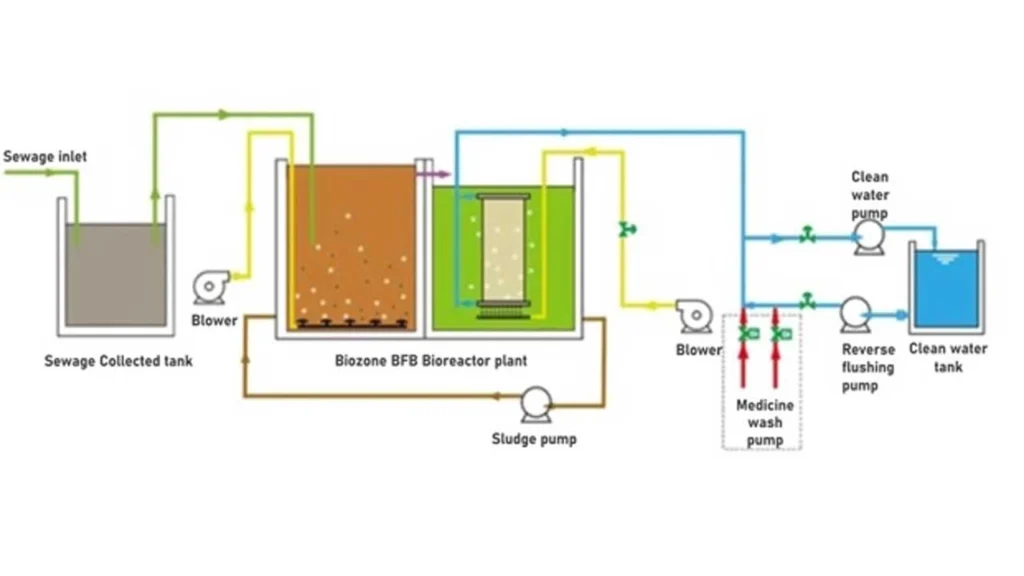
Instead of relying on holding tanks and periodic removal, a properly engineered BZMBR (Membrane Bioreactor) sewer treatment plant treats wastewater continuously, on site, at the volume your development actually produces. Sewage from washrooms and kitchens flows through pretreatment and screening, into a sewage collection and equalization tank, through the BZMBR treatment system, then disinfection, before discharge as clean water suitable for reuse. The result is a step beyond a standard biodigester septic tank: where a biodigester breaks waste down and holds it, this plant carries treatment through membrane filtration to a far higher effluent standard.
This is not a small drop-in unit. It is a designed treatment facility sized to your daily hydraulic load, built into your site’s civil works from the ground up.
Our Portfolio
Proven Results You Can Trust: From high-occupancy apartment complexes in Kiambu to premier commercial venues like The Waterfront Karen, Royal Golf Club, and Spectre East Africa, Biozone delivers proven wastewater treatment solutions that completely eliminate exhauster dependence and foul odors.
Our advanced biological systems and specialized bio-enzymes process sewage for hundreds of daily users, turning wastewater into clear, NEMA-compliant effluent ideal for lawn irrigation, landscaping, and sustainable reuse.
Whether you manage an executive residential property, a bustling commercial flat, or an industrial facility, Biozone guarantees long-term durability, zero clogging, and massive savings on maintenance, proven by our track record of flawless operation across Kenya since 2019.
How the BZMBR Wastewater Treatment Plant actually works
The treatment sequence follows a clear, engineered process:
- Primary screening. Non-biodegradable and floating solids such as plastics, tins, grit, and rocks are removed before they can damage downstream equipment. Screens use non-corrosive stainless steel or plastic media and are positioned to be accessible for routine cleaning.
- Pre-treatment and mixing. Effluent is dosed with an anaerobic microbial culture and enzymes, such as Septozyme BFB, reducing sludge volume, cutting odour, and speeding up bacterial oxidation from the very first stage.
- Equalization and sewage collection. A buffering tank absorbs peak flow variations, such as a full office building at lunchtime or a hotel at check-out, with feeding pumps moving effluent forward so the treatment process remains stable rather than overwhelmed.
- Aeration. A regenerative air blower feeds fine bubble disk diffusers, introducing air evenly into the bioreactor to break down organic matter through aerobic digestion. Dosing this stage with an aerobic culture such as Envirozyme BFB supports the process further. More than 85% of organic matter is decomposed at this stage alone.
- BZMBR bioreactor and membrane separation. Using a stainless steel and PVDF membrane module, this stage pushes BOD and COD reduction beyond 95%, ammonia nitrogen reduction beyond 98%, and suspended solids removal beyond 99%.
- Disinfection. A chlorine dosing pump removes remaining microorganisms before discharge; for irrigation use, treated water is either held to allow chlorine to deplete, or UV disinfection is used instead.
- Automated control. The entire plant runs under PLC automation, with thermal overload protection on motors, status lamps, and alarms for power failure, overloads, or flow issues, meaning the system runs itself rather than requiring constant staff attention.
Sludge that settles out along the way can be kept fully digested with periodic dosing of Bamoyeast BFB, and kitchens feeding grease and lipids into the system, common in hotels, hospitals, and staff canteens, are protected by dosing inlet lines with SeptoClean BFB before fats can build up and slow the treatment train.
What this actually means for you
- Built for real occupancy, not guesswork. The plant is sized to your actual daily sewage volume, whether that is 300 people or several thousand, so you are never caught undersized during peak use.
- No exhauster dependency, at scale. A holding tank and exhauster model simply cannot keep pace with high occupancy sites. Continuous on-site treatment removes that bottleneck entirely, along with the compliance risk of an overflow.
- Works where soak pits fail. Sites on clay soil, or with limited land for absorption fields, can still treat wastewater safely on site because discharge does not depend on soil infiltration.
- Treated water you can reuse. Effluent meets NEMA Schedule 6 guidelines, making it usable for irrigation, car washing, and pavement cleaning, an asset for large landscaped estates, hotels, and campuses rather than a pure cost centre.
- A revenue and cost offset most buyers do not expect. Biogas harnessed from the initial treatment stages can be used for heating during the treatment process, steam generation, cooking, or purified further for electricity generation, turning part of your waste stream into an operational input.
- Minimal daily staff burden. Full PLC automation, with built-in alarms and overload protection, means the plant runs continuously without needing an operator watching it around the clock.
- A known, predictable power draw. Installed mechanical and electrical capacity and daily electricity consumption are defined at the design stage, so this is a line item you can budget for, not an open-ended operating risk.
- Regulatory confidence built in. Performance is measured against NEMA and WHO parameters across pH, BOD, COD, TSS, and coliform counts, giving you documented compliance rather than a hope that a soak pit is working.
Who the BZMBR Wastewater Treatment Plant is built for
This system is engineered for developments and institutions where wastewater volume, compliance exposure, and site constraints rule out a conventional septic setup or a standalone biodigester:
- Property developers and estate owners building gated residential communities, office parks, or mixed-use developments where wastewater infrastructure must be designed in from the start.
- Hotels and hospitality properties with continuous, high volume guest usage and a direct reputational cost to any wastewater failure.
- Schools, hospitals, and other institutions that NEMA and public health guidance already identify as major sources of urban wastewater pollution, and that carry a compliance obligation their neighbours do not.
- Facilities and estate managers responsible for keeping an existing high occupancy site compliant, odour free, and free of recurring exhauster costs.
- Sites on constrained or clay-heavy land, where a conventional soak pit cannot be relied on regardless of budget.
Common questions, answered honestly
Does this replace our septic tank entirely? Yes. At this scale, the plant is designed as the primary treatment infrastructure for the site, built into the civil works rather than added on to an existing septic system or biodigester.
What does installation actually involve? This is a constructed facility. It requires masonry sub-structures built to engineering drawings, along with the mechanical components: feeding pumps, air blowers, the BZMBR module itself, and the control panel. It is planned alongside your site’s civil works, not fitted after the fact.
How much power does it use? Power draw is defined at the design stage based on your site’s installed mechanical and electrical capacity, so your daily electricity consumption is known in advance rather than estimated after installation.
Can the treated water actually be reused on site? Yes. Water from the aerobic treatment stage can be used for flushing and irrigation, and treated effluent meets NEMA Schedule 6 guidelines for irrigation and cleaning use.
What about odour and noise, given how many people will be using it? A deodorant stage using active carbon medium is built into the system, and the enclosed, automated process is designed to run without the odour issues associated with a full septic tank or holding system.
Is this compliant with NEMA and WHO requirements? Yes. Effluent quality is measured against NEMA and WHO parameters, including pH, BOD, COD, TSS, and coliform counts, with performance data available to support your compliance documentation.
The real cost comparison
At high occupancy, exhauster reliance does not scale, the cost and risk grow with every additional person on site, every missed collection becomes an overflow risk, and every overflow becomes a compliance and reputational problem. An engineered BZMBR Wastewater Treatment Plant is a capital investment made once, at the design stage of your development, rather than a recurring operating cost and liability that grows for as long as the property is in use. Factor in the biogas offset and the reusable water output, and the plant is not simply an expense; it is infrastructure that pays part of itself back.
Ready to plan wastewater infrastructure for your site?
If you are developing or managing a high occupancy property and need wastewater treatment designed in from the start, the next step is a site assessment. Our engineers will review your expected daily sewage volume, site conditions, and land constraints, and specify an BZMBR Wastewater Treatment Plant sized correctly for your development, with no obligation.
For more information, visit us at our office at the junction of Kahawa Sukari Avenue and Muranga Road in Kahawa Sukari, or contact us at +254 111 715 578 or info@biozone.co.ke.
FILL IN THE FORM BELOW TO GET A FREE QUOTE FOR YOUR WASTEWATER TREATMENT PLANT OR BIODIGESTER.