
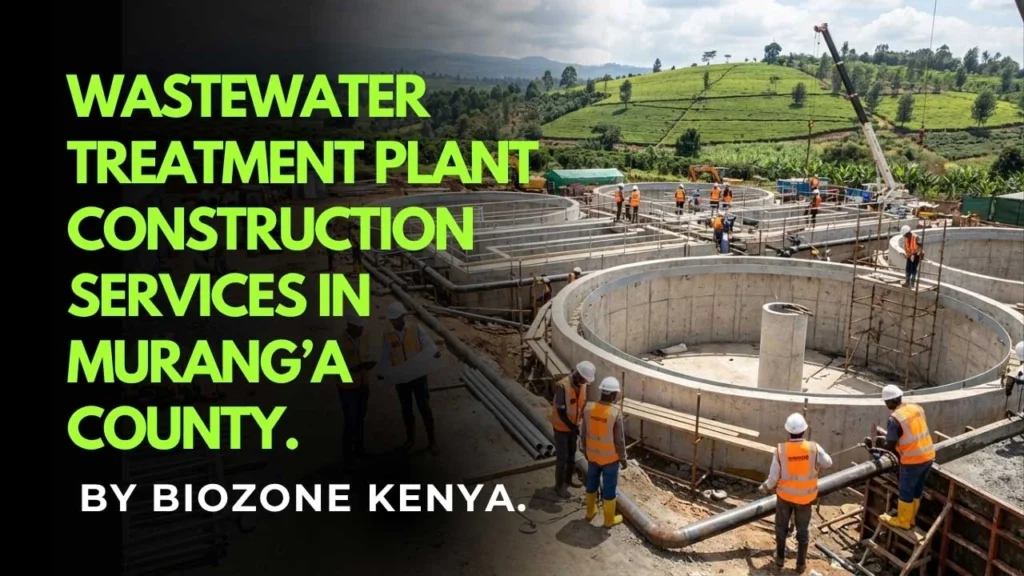
Wastewater Treatment Plant Construction in Murang’a: Why We Are Your Best Choice for This Service.
Murang’a County is changing fast. Once defined almost entirely by its tea estates and coffee cooperatives, the county is experiencing a surge in real estate development, agro-processing investment, and commercial growth, particularly along the Nairobi–Murang’a highway corridor and in expanding towns such as Kenol, Murang’a town, Kigumo, and Kangari.
With a population exceeding one million and development outpacing public infrastructure at every turn, wastewater treatment plant construction in Murang’a has moved from a niche technical requirement to an urgent, county-wide necessity.
The challenge is straightforward: Murang’a County has no meaningful centralised sewerage network. Across all seven constituencies, Kangema, Kiharu, Mathioya, Kigumo, Kandara, Maragwa, and Gatanga, residential estates, agro-processing facilities, institutions, and commercial premises generate wastewater daily with no sewer connection available. Every litre of that wastewater must be treated on-site, or it becomes an environmental liability and a legal violation.
The National Environment Management Authority (NEMA) enforces Kenya’s Water Quality Regulations, 2006, which set strict effluent discharge standards for all facilities. In Murang’a, a county whose rivers, including the Maragua, Mathioya, and Tana tributaries, supply water to communities and irrigation schemes across the wider region, the environmental stakes of untreated effluent are particularly high. Contaminating these water sources carries serious legal consequences and lasting damage to the agricultural economy that sustains the county.
Biozone (Blueflame Energy Solutions Ltd) has spent over 10 years designing, building, and maintaining biological wastewater treatment systems across Kenya, with more than 4,000 completed installations. Biozone brings full lifecycle expertise, from feasibility study and engineering design through construction, commissioning, and long-term maintenance, to every project in Murang’a County and the wider Central Region.
To begin with a wastewater treatment consultancy that assesses your site, your flow volumes, and your compliance requirements, contact Biozone’s engineering team today.
Who Needs Wastewater Treatment Plant Construction in Murang’a County?
Murang’a County’s development landscape creates distinct wastewater treatment needs across four client groups. Each faces different challenges, different wastewater characteristics, and different regulatory pressures.
Residential Developments
New apartment blocks, gated communities, and multi-unit housing estates are rising across Murang’a town, Kenol, Kangari, Kigumo, and the fast-developing Makuyu corridor. All of these areas sit outside any functional public sewer network. Developers who proceed without a compliant domestic wastewater treatment system risk NEMA enforcement action, project delays, and long-term liability for residents.
Biozone’s sewage water recycling systems are available from 4,000 litres, can be scaled to any estate size, and can fit sites as small as 2 square metres, critical flexibility for the compact urban plots and hillside developments typical of Murang’a County’s terrain. With a 5-year tank warranty and effluent performance verified at BOD 11 mg/litre and Ammoniacal Nitrogen 7 mg/litre, these systems produce effluent clean enough for irrigation reuse, a genuine operating advantage for residential developments with gardens, landscaping, or on-site farming.
Agro-Processing and Food Industries
Murang’a County is one of Kenya’s most productive agricultural counties, a top national producer of tea through KTDA, a major coffee-growing region, and home to macadamia and avocado processing operations, dairy facilities, and fruit value-addition units. The county also hosts large-scale agribusiness in the form of operations like Kakuzi Limited, which processes avocados, macadamia, and other produce.
This sector generates high-strength industrial wastewater characterised by elevated BOD and COD, suspended solids, fats, oils, and in some cases acidic process effluent requiring pH correction. A wastewater treatment system designed for domestic sewage will fail rapidly when exposed to agro-industrial loading. Biozone’s consultancy begins with a proper wastewater characterisation assessment, measuring the actual pollutant parameters of the specific process, before any technology is specified. This is the only approach that produces a system that genuinely works.
Commercial Properties
The commercial centres of Murang’a town and Kenol town, the growing hospitality strip along the Murang’a–Kenol road, market towns in Kandara and Kigumo, and petrol stations, guesthouses, and agro-vet centres across all seven constituencies generate commercial wastewater daily. These businesses operate entirely without sewer connections and require compact, reliable commercial sewage treatment systems that produce NEMA-compliant effluent with minimal operator input.
Institutions
Murang’a University of Technology (MUT) and the Kenya Medical Training College Murang’a Campus serve thousands of students and staff. Sub-county hospitals in Kangema, Kigumo, Kandara, and Maragwa, government administration facilities, secondary schools, and NGO campuses across all seven constituencies generate substantial daily wastewater volumes. These institutions face the highest levels of public and regulatory scrutiny, and require wastewater treatment systems that are reliable, NEMA-compliant, and capable of producing effluent safe for on-site reuse.
Biozone’s Services: Full Lifecycle Wastewater Treatment Plant Construction in Murang’a
Biozone provides end-to-end service across every phase of a wastewater treatment project. The most common cause of system failure in Kenya is not flawed technology, it is the absence of proper design, incorrect commissioning, or no maintenance after handover. Biozone’s process is designed to prevent every one of these failures.
Feasibility & Site Assessment
Every project begins with a site visit. Biozone’s engineers examine the topography, spatial constraints, soil conditions, proximity to water sources, and access routes. Daily flow is calculated from population data, facility type, and operating patterns. For agro-processing facilities, process water volumes and pollutant loading are assessed separately. The outcome is a design brief that reflects the actual site, not a generic specification.
Engineering Design
Biozone produces complete hydraulic designs, technology selections, technical drawings, and Bills of Quantities (BOQ) for every installation. For Murang’a County’s mix of residential, agro-industrial, and institutional clients, design must account for seasonal variation, production peaks, and in some cases the specific chemistry of process effluent. The design stage is where cost is controlled and performance is guaranteed, not during construction.
Construction & Civil Works
All civil construction follows the Ministry of Water and Irrigation guidelines (December 2008). Reinforced concrete is specified and poured to the correct class, waterproofing additives are used at the recommended ratio, and curing periods are strictly observed, a minimum of 21 days for structural elements, 14 days before formwork removal. Inspection chambers are sized for proper maintenance access. Properly built concrete infrastructure will not leak, crack, or allow groundwater infiltration.
Equipment Supply & Installation
Biozone supplies and installs all mechanical, electrical, and instrumentation components. Wastewater treatment appliances and equipment, including air blowers, filtration media, UV disinfection units, dosing pumps, and chemical tanks, are specified based on the process design and sourced to match the treatment requirements of each project.
Commissioning & Testing
Before every handover, the system is commissioned and tested against its design performance targets. Biological cultures are established, effluent quality is verified, alarms are tested, and operators are trained on daily procedures, fault responses, and routine maintenance. A system handed over without commissioning is a system the client cannot operate correctly.
Operations & Maintenance
Biozone provides ongoing biodigester maintenance and rehabilitation plans after installation, covering periodic inspections, biological culture management, mechanical servicing, sludge handling, and emergency support. Biozone’s track record includes installations verified functioning efficiently five or more years after commissioning, with consistent maintenance as the key factor.
How Wastewater Treatment Works: Understanding the Process
A clear understanding of the sewage treatment process helps clients make better decisions about technology selection, system sizing, and what to expect from their installation.
Preliminary Treatment
Screening removes large solids, rags, plastics, debris, that would damage downstream equipment. Grit removal settles heavy inorganic particles such as sand and gravel. These two steps protect pumps, aerators, and biological reactors from physical damage and blockage.
Primary Treatment
In a sedimentation tank (primary clarifier), gravity separates suspended solids downward as primary sludge, while floatable materials, grease, oils, are skimmed from the surface. Primary treatment removes 50–70% of suspended solids and approximately 25–40% of biochemical oxygen demand (BOD), but does not address dissolved organics, nitrogen, or phosphorus, which are handled in secondary treatment.
Secondary Treatment, Biological Wastewater Treatment
Biological wastewater treatment is the core of any effective sewage treatment plant. Microorganisms consume dissolved organic matter in the wastewater, converting it to carbon dioxide, water, and biomass.
Activated sludge treatment, the most widely used secondary process globally, introduces air into an aeration tank containing wastewater and a dense microbial population (the mixed liquor). After aeration, the mixed liquor flows to a secondary clarifier where biological solids settle. A portion, return activated sludge (RAS), is recycled to maintain the biological population. The remainder, waste activated sludge (WAS), is removed for sludge treatment and disposal.
Nitrification converts ammonia to nitrate using specialist bacteria (Nitrosomonas and Nitrobacter) under aerobic conditions. Denitrification then converts nitrate to harmless nitrogen gas under anoxic conditions. Together, these processes remove nitrogen, a nutrient that causes eutrophication in rivers and streams, and that must be reduced to acceptable levels before effluent is discharged in Murang’a County’s sensitive river catchments.
Biozone’s systems achieve verified effluent performance of BOD 11 mg/litre and Ammoniacal Nitrogen 7 mg/litre, clean, odourless output that meets NEMA discharge standards and is safe for agricultural irrigation reuse. For the full range of Biozone’s treatment systems, see the sewage water recycling systems page.
The WHO guidelines on wastewater reuse provide internationally recognised standards for the safe use of treated effluent in agriculture, directly applicable to Murang’a County’s predominantly agricultural setting.
Tertiary Treatment
Filtration, UV disinfection, chlorination, and nutrient polishing produce reuse-quality effluent. Tertiary treatment is particularly relevant where treated water will be used for drip irrigation on tea, coffee, or horticulture plots, or for non-potable uses in institutional and commercial buildings.
Effluent Disposal or Reuse
Treated effluent can be discharged to a watercourse (with a valid NEMA discharge licence and WRA permit), used for land irrigation, applied to non-potable building services, or recharged to groundwater via a correctly designed soakage trench. In Murang’a County’s agricultural environment, treated effluent reused for irrigation is not merely a compliance outcome, it is a water and nutrient asset that reduces the cost of crop production.
Planning & Design Considerations for Wastewater Treatment Plant Construction in Murang’a
Sound planning before construction begins is the single most important factor in long-term system performance. No amount of quality construction can compensate for a flawed design.
Flow Rates and System Sizing
System size is determined by daily flow volume (m³/day) and population equivalent (PE). A tea factory operating at peak processing season has fundamentally different loading characteristics from a school or a residential estate. Accurate flow estimation requires site data, occupancy numbers, operating hours, seasonal patterns, and in the case of food processing, the volume of process water used per unit of production.
Site Selection Criteria
Ideal plant placement is downhill from the source (enabling gravity flow and reducing pumping costs), away from water abstraction points, and on ground with stable soil conditions. In Murang’a County’s varied terrain, from the highland slopes of Kangema and Mathioya to the lower Ithanga and Maragwa plains, topography plays a significant role in system layout and cost. Rocky highland ground increases excavation cost; expansive soils in lowland areas affect soakage trench design and sludge drying bed performance.
Centralised vs. Decentralised Wastewater Treatment
Centralised systems collect wastewater from multiple sources via a reticulation network and treat it at a single plant, efficient at scale but requiring significant pipe infrastructure. Decentralised wastewater treatment places treatment units at or near the source, which is the practical reality for almost all developments in Murang’a County given the absence of a reticulation network. Modular wastewater treatment plants are particularly well suited to the county’s phased development pattern, allowing capacity to be added as a residential estate, institution, or processing facility grows.
NEMA Environmental Impact Assessment (EIA)
Construction of a wastewater treatment plant in Kenya that meets NEMA’s prescribed thresholds requires an approved Environmental Impact Assessment (EIA) before works begin. Biozone’s consultancy supports clients through the full EIA process, from initial documentation and site impact assessment to submission and approval follow-up with NEMA.
Cost of Wastewater Treatment Plant Construction in Murang’a County
The cost of wastewater treatment plant construction in Murang’a varies significantly across projects. Understanding what drives cost allows clients to plan accurately and evaluate quotations fairly.
What Determines the Cost
- Flow capacity (m³/day) is the primary cost driver, a small residential system at 20 m³/day costs a fraction of an agro-processing plant treating 300 m³/day
- Treatment technology, MBR systems carry higher capital costs than SBR, ASBR, or conventional activated sludge, but produce higher-quality effluent with a smaller footprint
- Site conditions, Murang’a County’s terrain ranges from rocky highland to lowland clay; excavation costs vary significantly depending on ground conditions, depth required, and site access
- Wastewater characteristics, high-strength agro-industrial effluent requires more robust treatment than domestic sewage, affecting technology selection and capital cost
- Level of automation, manual systems cost less upfront but require more operator time; automated systems with alarms and remote monitoring reduce operational risk
- Equipment origin, locally available components reduce cost and lead time; specialist imported items add both
CAPEX vs. OPEX, Total Cost of Ownership
Capital expenditure (CAPEX) covers feasibility, design, construction, equipment supply, and commissioning. Operational expenditure (OPEX) covers energy, chemicals, sludge disposal, planned maintenance, and labour. These two figures must always be considered together. A system with very low CAPEX, built without proper design or using undersized components, will almost always generate high OPEX through excessive energy use, chemical dosing, early equipment failure, and eventual system replacement. The correct question is not “what does it cost to build?” but “what does it cost to own over 10 to 20 years?”
Small Wastewater Treatment Plant Cost
For septic-scale biodigester systems, appropriate for single properties, small commercial premises, or sites generating under 20 m³/day, Biozone’s construction costs range from KSh 85,000 to KSh 230,000, depending on size, soil conditions, location, and the intended use of the treated effluent. For full mechanical wastewater treatment plants serving residential estates, agro-processing facilities, institutions, or commercial developments in Murang’a County, costs are assessed per project following a site visit and detailed flow analysis.
Why Quotations Vary Widely
Two quotations for a “wastewater treatment plant” can differ by 200–400% and still describe fundamentally different systems. A low-cost quotation may exclude design, commissioning, operator training, sludge management infrastructure, and maintenance, all of which are non-optional. Biozone provides detailed, itemised quotations after a site assessment, so clients understand exactly what is included and why it is priced accordingly.
[Request a cost estimate, request a site assessment]
Technology Comparison: Choosing the Right System for Murang’a County
No single technology suits every site. Biozone’s engineers recommend the system that best matches each project’s site conditions, wastewater characteristics, available space, budget, and effluent reuse goals. The table below compares the technologies Biozone works with:
| Technology | Best For | Key Advantage | Limitation |
| Activated Sludge | Medium–large agro-industrial and institutional plants | Proven, flexible, cost-effective at scale | Requires larger land footprint |
| ASBR, BZM Fix Model | Large communities; full C&N removal required | Odour-free, reuse-quality effluent; robust biological process | Requires consistent power supply |
| SBR, BZM Model | Variable flows; residential estates to large communities | Full C&N removal; suitable for irrigation and toilet flushing reuse | Batch process; timing-sensitive |
| MBR (Membrane Bioreactor) | Space-constrained sites; highest effluent quality required | Most compact footprint; superior effluent quality | Highest CAPEX and energy cost |
| MBBR (Moving Bed Biofilm Reactor) | Plant upgrades; agro-processing sites with variable loads | Highly flexible; robust to seasonal and production load variation | May require a polishing step |
| Modular / Packaged Plants | Phased developments; remote agro-processing sites | Fast deployment; expandable as development grows | Higher unit cost at large scale |
After the table, Biozone’s engineering team assesses each project individually, factoring in Murang’a County’s specific site conditions, the nature of the wastewater, and the client’s long-term effluent reuse goals, before recommending a technology. For sites where the challenge is primarily domestic or small-scale, biodigester septic tanks offer a proven, lower-cost biological treatment option. For existing systems that are underperforming, Biozone’s consultancy covers all of the above technologies, including specialist wastewater enzymes and microbes that support biological treatment performance.
The EPA technical overview of MBBR systems is a useful technical reference for agro-processing clients in Murang’a County evaluating moving bed technology for variable-load industrial applications.
Sludge Management: The Compliance Obligation That Is Often Overlooked
Every wastewater treatment plant produces sludge, accumulated biological and inorganic solids separated from the liquid stream during treatment. Sludge management is a legal compliance requirement, not an optional afterthought. Poorly managed sludge causes odour complaints, environmental violations, and in many cases system failure as solids accumulate beyond designed capacity.
Sludge thickening concentrates solids to reduce volume. Sludge stabilisation through aerobic or anaerobic digestion reduces pathogen concentration and volatile solids, making the sludge safer and less odorous. Sludge dewatering, using belt press filters, centrifuges, or sun-drying beds, produces a semi-solid cake that is cheaper and easier to transport and dispose of.
For smaller systems in Murang’a County, sludge drying beds are often the most practical dewatering approach. Dried sludge, stabilised and pathogen-reduced, can in appropriate cases be applied to agricultural land as a soil conditioner, a circular resource recovery outcome consistent with Murang’a County’s agricultural economy.
Biozone’s systems include a sludge return facility as a standard feature, which recycles settled sludge within the biological reactor to support denitrification and maintain system stability during periods of reduced use.
Sludge disposal must comply with NEMA regulations. Approved pathways include land application (where soil conditions and groundwater depth are suitable), composting, and disposal to licensed landfill. Biozone advises clients on the most appropriate disposal route for each installation.
Common Challenges and How Biozone Prevents Them
Most wastewater treatment failures are not caused by technology limitations. They are caused by avoidable errors in design, construction, commissioning, or maintenance.
Undersized systems result from poor flow estimation. Biozone conducts detailed site surveys and hydraulic calculations before any design is finalised, accounting for peak loads, seasonal variation, and future growth.
Technology mismatch occurs when a process is specified without understanding the actual wastewater. A system designed for domestic sewage will fail when exposed to high-strength tea factory effluent or dairy processing waste. Biozone’s consultancy assesses wastewater characteristics before technology selection.
Poor civil construction leads to leaking tanks, structural cracking, and groundwater contamination, all of which create both compliance failure and costly remediation. Biozone’s construction follows Ministry of Water and Irrigation guidelines, with correct concrete mixes, waterproofing, reinforcement, and curing.
No commissioning is common with contractors who build and walk away. Biozone includes biological startup, performance testing, and operator training as standard before every handover.
No maintenance plan is the single most common cause of long-term system failure. Biozone provides biodigester maintenance and rehabilitation plans tailored to each installation, preventing failures before they occur.
NEMA non-compliance, operating without a discharge consent or EIA approval, exposes facility owners to enforcement, fines, and forced closure. Biozone supports clients through the full licence application process from the outset.
To review Biozone’s completed installations across Kenya, view our project portfolio.
Regulatory Compliance in Kenya: What Murang’a County Developers Must Know
Navigating Kenya’s regulatory environment is non-negotiable for any wastewater treatment project. Failure to comply is not a minor administrative risk, it can result in criminal liability, facility closure, and mandatory environmental remediation.
NEMA: National Environment Management Authority
The National Environment Management Authority (NEMA) sets and enforces effluent discharge standards under the Environmental Management and Co-ordination (Water Quality) Regulations, 2006. Any facility discharging treated effluent must hold a valid NEMA discharge licence. The construction of a new wastewater treatment plant that meets NEMA’s prescribed thresholds also requires an approved Environmental Impact Assessment (EIA) before works begin. Biozone assists clients in preparing EIA documentation, managing stakeholder engagement, and navigating the NEMA submission and approval process.
WRA: Water Resources Authority
The Water Resources Authority (WRA) regulates abstraction and discharge to Kenya’s water bodies. Given Murang’a County’s significant river network, including Maragua, Mathioya, and tributaries feeding the Tana River, any project discharging treated effluent to a natural watercourse requires a WRA permit in addition to a NEMA discharge licence. Biozone’s consultancy includes support for WRA permit applications where required.
County Government of Murang’a
The Murang’a County Government issues development permits and building approvals for construction projects. Early engagement with the county planning department avoids costly delays and ensures that approvals are obtained in the correct sequence, EIA approval before construction; discharge licence before commissioning.
Consequences of Non-Compliance
Operating without required consents exposes the facility owner and directors to NEMA fines, WRA enforcement action, forced shutdown, mandatory remediation, and reputational damage. NEMA enforcement activities are intensifying across Kenya, with industrial and commercial facilities, including agro-processing operations, among the primary targets for inspection. Compliance is a legal obligation, not an optional enhancement.
Emerging Trends in Wastewater Treatment
The wastewater treatment sector in Kenya is evolving rapidly, driven by regulatory tightening, water scarcity, and the growing economic logic of resource recovery from waste streams.
Wastewater recycling and water reuse is increasingly relevant in Murang’a County, where irrigation demand is high, water supply can be seasonal, and the cost of abstraction is rising. Treated effluent meeting appropriate standards can safely and legally be reused for crop irrigation, tea estate watering, nursery management, and non-potable building services, significantly reducing dependence on freshwater abstraction.
Biogas energy recovery from sludge is an established technology with direct relevance to Murang’a County’s agro-processing sector. Tea factories, dairy processors, and fruit processing operations generating high organic loads can convert digested sludge into biogas, reducing energy costs and creating a circular resource recovery loop. Biozone has direct expertise in biological water recycling solutions and biogas systems that support this approach.
Decentralised and modular treatment is the practical reality of wastewater management in a county like Murang’a, where centralised sewer infrastructure is absent across most of the land area. Modular systems installed at the estate, factory, or institution level offer the fastest route to compliance and can be expanded as the facility grows.
Smart monitoring and remote SCADA systems allow operators to monitor treatment performance, receive alarms, and adjust process parameters remotely, particularly valuable for agro-processing facilities where wastewater characteristics change significantly between crop seasons.
Biozone’s mission, transforming waste into a valuable resource while protecting the environment, is directly aligned with UN SDG 6: Clean Water and Sanitation, which recognises wastewater treatment as a fundamental pillar of sustainable development.
Areas We Serve in Murang’a County
Biozone provides wastewater treatment plant construction in Murang’a across the full extent of the county, all seven constituencies and the full range of urban, peri-urban, agro-industrial, and rural development contexts.
Across Kiharu Constituency, home to Murang’a town, the county capital and its most densely developed urban area, Biozone serves residential developers, commercial businesses, institutions, and the expanding hospitality sector. In Kangema Constituency, the highland agricultural and processing economy, built on tea, coffee, and dairy, generates significant industrial wastewater from factories in and around Kangema township and adjacent centres such as Gakira, Gitugu, and Kanyenya-ini.
In Mathioya Constituency, along the Mathioya and Irati river valleys, agro-processing facilities and residential growth require systems that protect the sensitive river environment. Kigumo Constituency, centred on Kigumo town and Kangari, is experiencing rapid residential and commercial development that has outpaced any sewerage provision. Kandara Constituency, one of the county’s most densely populated sub-counties, combines intensive smallholder farming with growing commercial activity in Kandara town and surrounding market centres.
Maragwa Constituency, including the fast-growing town of Kenol along the Nairobi–Embu highway, is one of the county’s most dynamic commercial zones. Kenol’s hotels, shops, agro-processing units, and residential developments are all off-sewer and require independent treatment systems. Gatanga Constituency, the county’s most populous sub-county, stretches from highland tea country toward the Tana River lowlands, combining agricultural processing, rural institutional needs, and growing residential development in Gatanga town and surrounding centres.
Key towns and commercial centres served across the county include Murang’a town, Kenol, Kigumo, Kangari, Kandara, Kangema, Maragwa, Makuyu, Gaichanjiru, Kiria-ini, Kahuro, and Kirwara. Biozone also serves institutions, farms, and processing facilities in the highland areas of Ndaka-ini, Githunguri (border zone), and the lower agricultural plains of Ithanga.
If your specific location is not listed, contact Biozone directly. Biozone serves the full Murang’a County area and the wider Central Region.
Why Choose Biozone for Wastewater Treatment Plant Construction in Murang’a?
There are many contractors who will supply and install a tank in Murang’a and call it a wastewater treatment plant. The difference between that and a system that performs correctly, complies with NEMA standards, and lasts 20 years lies entirely in the engineering expertise, construction quality, and maintenance commitment behind it.
Over 10 years of experience with more than 4,000 clients served across Kenya, from single residential properties to large institutional and industrial installations. Biozone’s track record includes systems verified functioning efficiently five or more years after installation.
Proven effluent quality. Biozone achieves a verified BOD of 11 mg/litre and Ammoniacal Nitrogen of 7 mg/litre, clean, odourless effluent that meets NEMA discharge standards and is safe for agricultural irrigation reuse across Murang’a County’s farming landscape.
A 5-year tank warranty on installed systems, a direct commitment to construction quality.
Technology-agnostic design. Biozone recommends the right system for each project, whether ASBR, SBR, MBR, MBBR, activated sludge, or modular packaged plant, based on site conditions and performance requirements, not convenience or stock availability.
Full lifecycle service. Feasibility, design, construction, commissioning, operator training, and long-term maintenance, Biozone is involved throughout, not just at the point of installation.
NEMA compliance support. EIA documentation, discharge licence applications to both NEMA and WRA, and ongoing compliance monitoring, Biozone removes the most complex administrative burden from the client.
149 Google reviews and a growing portfolio of long-running, verified installations across Kenya.
Minimum footprint from 2 sq m, meaning compact institutional sites, hillside developments, and tight commercial plots in Murang’a County all have a viable treatment solution.
Frequently Asked Questions About Wastewater Treatment Plant Construction in Murang’a
What is the difference between a septic tank and a wastewater treatment plant?
A conventional septic tank stores wastewater and allows partial settling but does not treat it to any meaningful environmental standard. A biodigester septic tank improves on this by using biological processes to break down organic matter, but still typically requires effluent disposal via a soak pit. A full wastewater treatment plant, SBR, ASBR, MBR, or activated sludge, processes wastewater through multiple biological and physical stages to produce clean, odourless effluent that meets NEMA discharge standards and can be safely reused for irrigation or discharged to water bodies.
How much does wastewater treatment plant construction in Murang’a cost?
Costs vary based on system capacity, treatment technology, site conditions, and wastewater characteristics. Biozone’s septic-scale biodigester systems range from KSh 85,000 to KSh 230,000. Full mechanical wastewater treatment plants for residential estates, agro-processing facilities, or institutions are costed per project following a site visit and flow analysis. A detailed, itemised quotation is always more reliable than a ballpark figure for planning purposes.
How long does it take to build a wastewater treatment plant in Murang’a County?
A site assessment and design proposal typically takes two to four weeks. Construction of a small to medium residential or commercial system takes four to eight weeks. Larger agro-industrial or institutional plants involving significant civil works take three to six months from design sign-off to commissioning. Where a NEMA EIA is required, this process should begin before construction contracts are signed, as approval lead times must be factored into the overall project programme.
Do I need NEMA approval for wastewater treatment plant construction in Murang’a?
Yes, in most cases. The Environmental Management and Co-ordination Act requires a NEMA-approved Environmental Impact Assessment for projects that meet prescribed thresholds, which most wastewater treatment plants do. A NEMA discharge licence is also required before treated effluent can legally be discharged. Where discharge is to a river or stream, common in Murang’a County, a WRA permit is additionally required. Biozone’s consultancy supports clients through both application processes.
What happens to the treated water after the treatment process?
Depending on the treatment level achieved and the discharge consent in place, treated effluent can be discharged to a watercourse, used for crop irrigation, applied to building services such as toilet flushing, or recharged to groundwater via a soakage trench. Biozone’s systems achieve BOD 11 mg/litre and Ammoniacal Nitrogen 7 mg/litre, effluent quality suitable for agricultural irrigation reuse across Murang’a County’s farming areas.
What are the ongoing maintenance requirements for a wastewater treatment plant?
A biological treatment plant requires periodic professional inspection, enzyme and microbial culture management, mechanical servicing of blowers and pumps, sludge removal at intervals determined by the system’s loading rate, and effluent quality monitoring. Most systems require at minimum a quarterly professional inspection. Biozone provides biodigester maintenance and rehabilitation plans tailored to each installation, preventing costly failures rather than responding to them after the fact.
Can the system be expanded as my development grows?
Yes, particularly with modular and packaged systems, which are designed for phased expansion from the outset. Even concrete-constructed systems can be expanded by adding parallel treatment capacity. Biozone accounts for future expansion requirements at the design stage, so that growth, when it occurs, does not require demolishing and rebuilding the existing installation.
Which treatment technology is right for my tea factory or agro-processing facility?
The right technology depends on the specific wastewater characteristics of your process, BOD loading, COD, temperature, pH, fats, and suspended solids, as well as your available space, budget, and whether effluent will be discharged or reused. MBBR and activated sludge systems are well suited to variable industrial loads. SBR and ASBR systems perform well for high-strength effluent with full nitrogen removal. Biozone’s consultancy begins with a wastewater characterisation before any technology is recommended.
Can treated effluent be reused for irrigation on tea or coffee farms?
Yes. Biozone’s systems produce effluent with BOD 11 mg/litre and Ammoniacal Nitrogen 7 mg/litre, quality that meets standards for agricultural irrigation reuse under Kenyan regulations. In Murang’a County’s agricultural landscape, reusing treated effluent for irrigation is both a practical and economically attractive outcome, reducing freshwater abstraction costs and contributing to sustainable farm management.
What areas of Murang’a County does Biozone serve?
Biozone serves the full Murang’a County area across all seven constituencies: Kangema, Kiharu, Mathioya, Kigumo, Kandara, Maragwa, and Gatanga, including the towns of Murang’a, Kenol, Kigumo, Kangari, Kandara, Kangema, Maragwa, Makuyu, and surrounding rural, agro-industrial, and institutional sites. Contact Biozone directly for any location not listed.
Are You Ready to Start Wastewater Treatment Plant Construction in Murang’a County for Yourself, Your Business, or Organization?
Murang’a County’s development is accelerating. NEMA enforcement is intensifying. The rivers that sustain the county’s agriculture and supply water to downstream communities are under increasing pressure from inadequately treated effluent. The cost of getting wastewater treatment wrong, in system failure, non-compliance penalties, and environmental damage, is rising every year.
Biozone brings over 10 years of proven expertise, 4,000+ completed installations, and a full lifecycle service to every wastewater treatment project in Murang’a County. Whether you are developing a residential estate in Kenol, commissioning a tea factory effluent system in Kangema, building a new institution in Kigumo, or upgrading a failing system anywhere across the county, Biozone has the engineering capability and the verified track record to deliver a system that works.
What you get when you contact Biozone:
- A site assessment by a qualified engineer
- A detailed, itemised quotation based on actual site conditions and flow analysis
- Technology recommendations matched to your wastewater characteristics, budget, and reuse goals
- Full NEMA and WRA compliance support, from EIA through to discharge licence application
- A 5-year tank guarantee on installed systems
- Long-term maintenance plans to protect your investment and ensure ongoing compliance
Request a site assessment and speak to an engineer who understands Murang’a County’s specific infrastructure, agricultural, and compliance landscape.
Call or WhatsApp: +254 111 715 578 Email: info@biozone.co.ke Office hours: Monday–Friday 8:30am–5:00pm | Saturday 9:00am–12:00pm