
For Forest Compliance, Sugar Industry Effluent, and Dense Peri-Urban Populations!
★★★★★ 5.0 Rating: 215 Google Reviews | 4,000+ Projects Delivered | 10+ Years in Kenya | Verified BOD Output: 11 mg/L
Kakamega County presents some of Kenya’s most demanding wastewater management conditions. With a population approaching 1.87 million, the county’s formal sewer network covers only a fraction of its urban and peri-urban areas. From the sugar-processing belt in Mumias to the ecologically sensitive buffer zones surrounding Kakamega Forest National Reserve, the need for engineered, NEMA-compliant wastewater treatment has never been more urgent.
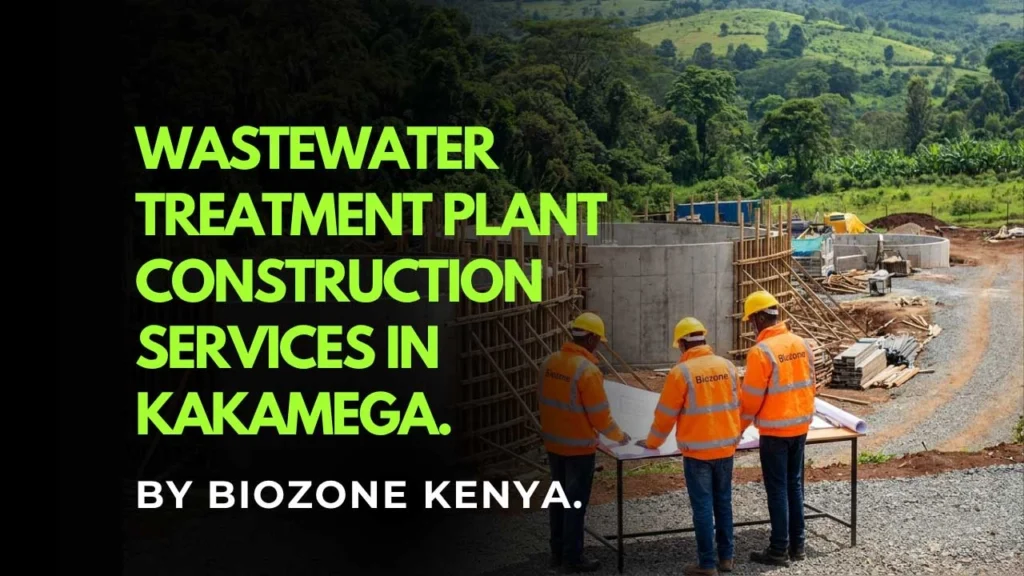
Biozone (Blueflame Energy Solutions Ltd) offers the best services in Wastewater Treatment Plant Construction in Kakamega. We have been delivering verified wastewater treatment solutions across Kenya since 2015, and our team brings the technical depth and regulatory knowledge to serve every constituency in Kakamega County.
- Compliant treated effluent meeting Kakamega Forest buffer zone and Lake Victoria catchment discharge standards
- High-BOD sugar industry wastewater treatment using proven biological processes
- Solutions for dense peri-urban estates in Kakamega Town, Mumias, Malava, and beyond
- Verified effluent quality: BOD 11 mg/L, Ammoniacal Nitrogen 7 mg/L, odourless and clear
- Full EIA support for projects in or near Kakamega Forest National Reserve
Get Your Site Assessment or Call/WhatsApp: +254 111 715 578
Not sure which technology suits your site? Our wastewater treatment consultancy team will assess your flow rates, soil conditions, and regulatory requirements and recommend the right engineered solution.
The Wastewater Challenge in Kakamega County
Kakamega is one of Kenya’s most populous counties, yet formal sewer infrastructure remains extremely limited. Across all 12 constituencies, including Lurambi, Mumias East, Mumias West, Malava, Navakholo, and Lugari, most households and commercial facilities depend on pit latrines, failing septic tanks, or exhauster truck services. This creates chronic groundwater contamination, public health risks, and escalating operating costs for facility managers.
The ecological stakes in Kakamega are particularly high. Kakamega Forest National Reserve, Kenya’s only remaining tropical rainforest, sits within the county and its drainage catchment is acutely sensitive to effluent contamination. Rivers including the Isiukhu, Yala, and Nzoia drain through the county toward Lake Victoria, meaning any untreated or poorly treated discharge carries significant downstream and cross-border environmental consequences. The National Environment Management Authority (NEMA) enforces strict water quality standards in this catchment.
In the Mumias Sugar belt, high-volume, high-Biochemical Oxygen Demand (BOD) effluent from processing operations requires industrial-grade treatment systems capable of meeting NEMA effluent class limits. The combination of ecological sensitivity, growing population, and agricultural-industrial activity makes Kakamega one of the most critical WWTP deployment areas in western Kenya.
Biozone’s proven wastewater treatment plant construction in Kenya covers precisely these complex, multi-sector environments. Whether your project is in a dense urban township or a remote tea-growing region, we have the technology and experience to deliver.
Who Needs a Wastewater Treatment Plant in Kakamega?
The demand for engineered wastewater treatment spans virtually every sector operating in Kakamega County. Below are the four primary client categories driving WWTP installation demand across the county.
Residential Estates and Peri-Urban Housing
Kakamega Town is growing rapidly, and peri-urban estates across Lurambi, Likuyani, and Shinyalu face acute on-site sanitation limitations. Multi-unit apartments and housing developments cannot sustain exhauster truck dependency as they scale. A properly sized biodigester or Sequencing Batch Reactor (SBR) system eliminates that dependency, produces reusable effluent, and adds lasting value to property.
Commercial Facilities
Hotels, guesthouses, market facilities, and commercial buildings along the Kisumu-Kakamega highway and within Kakamega Town generate significant wastewater volumes. Many operate in areas with no municipal sewer connection. Biozone’s compact systems, starting from a footprint of just 2 square metres, suit even constrained commercial sites.
Industrial Facilities in the Sugar Belt and Beyond
The Mumias Sugar belt generates some of the highest-BOD effluent volumes in western Kenya. Outgrower facilities, abattoirs, dairy processors, and agro-processors also require engineered treatment to meet NEMA Water Quality Regulations. Our sewage water recycling systems include technology capable of full carbon and nitrogen removal for these demanding waste streams.
Institutional Facilities
Masinde Muliro University of Science and Technology, Kakamega County General Hospital, Kakamega High School, Friends School Kamusinga, and Kenya Medical Training College all generate significant wastewater loads. Institutional facilities require reliable, low-maintenance systems with alarm capabilities and clear effluent output suitable for supervised environments.
Wastewater Treatment Plant Construction Services in Kakamega: By Client Type
Wastewater Treatment Plant Construction for Sugar Processing Factories and Outgrower Facilities in Kakamega
The Mumias Sugar Company and its surrounding outgrower belt produce effluent characterised by very high BOD, suspended solids, and organic loading. Standard septic systems cannot manage this waste stream. Biozone designs and constructs Anaerobic Sequencing Batch Reactors (ASBR) using the BZM Fix Model for large-volume industrial applications, delivering full carbon and nitrogen removal and producing effluent suitable for controlled land application or discharge. All systems are sized to handle peak processing season volumes and include automated monitoring and alarms.
Wastewater Treatment Plant Construction for Residential Apartments and Estates in Kakamega Town and Mumias
Multi-storey apartment developments in Kakamega Town, Mumias, Malava, and Lumakanda require treatment systems that handle variable daily flows without odour, noise, or maintenance disruption. Biozone’s SBR systems (BZM Model) serve residential populations from a single household to large apartment complexes. The systems operate quietly, require minimal intervention, and produce treated effluent that can be safely used for toilet flushing or landscape irrigation, eliminating exhauster truck costs permanently. One verified Biozone installation has kept an apartment complex exhauster-free for over two years.
Wastewater Treatment Plant Construction for Hospitals and Health Centres in Kakamega
Kakamega County General Hospital, sub-county hospitals, health centres, and private clinics generate wastewater containing pathogens, pharmaceutical residues, and elevated organic loads. Biozone designs institutional healthcare WWTP systems with UV disinfection units and advanced secondary treatment to meet the elevated compliance standards required for healthcare facilities. EIA documentation, discharge licence applications, and ongoing maintenance support are all included in our service package.
Wastewater Treatment Plant Construction for Schools, Colleges, and Universities in Kakamega
Large boarding schools such as Kakamega High School and Friends School Kamusinga, along with Masinde Muliro University of Science and Technology and Western University, accommodate thousands of students and staff generating substantial wastewater volumes daily. Biozone’s systems for institutional education facilities are designed for low electricity consumption, minimal manual intervention, and long operational life. Compact footprints allow installation within existing campus grounds without major civil disruption.
Wastewater Treatment Plant Construction for Hotels and Guesthouses in Kakamega
Tourism and hospitality facilities in Kakamega Town, around Kakamega Forest, and along key transport corridors need WWTP solutions that are odour-free and aesthetically unobtrusive. Biozone’s above-ground installation option and compact system designs suit hotel compounds where space is at a premium. Treated water can be recycled for garden irrigation, reducing water bills significantly.
Wastewater Treatment Plant Construction for Dairy Processing and Agro-Processing Facilities in Kakamega
Dairy cooperatives, milk processors, tea-processing factories, and horticulture packhouses in Kakamega County generate high-strength effluent with elevated fats, oils, and organic solids. Biozone engineers pre-treatment and primary settlement stages alongside secondary biological treatment to handle these specific waste characteristics. The result is consistent effluent quality that protects local watercourses and meets NEMA class standards for agricultural discharge.
Wastewater Treatment Plant Construction for Slaughterhouses and Abattoirs in Kakamega
Abattoirs and slaughter slabs operating in Kakamega County produce blood, grease, and high-BOD effluent that poses serious environmental and public health risks if untreated. Biozone’s specialist abattoir WWTP designs incorporate fat traps, anaerobic pre-treatment, and biological polishing stages. Our systems are compliant with Kenya Meat Commission standards and NEMA effluent class limits, and can be designed to treat wastewater from both small-scale rural slaughter points and larger commercial abattoirs.
Wastewater Treatment Plant Construction for Government and Public Facilities in Kakamega
County government offices, public markets, bus parks, and community facilities across Kakamega County require affordable, low-maintenance wastewater treatment. Biozone works with county governments, the National Construction Authority, and public works departments to design and construct systems that meet procurement requirements and are backed by a five-year tank warranty and clear maintenance schedules.
Wastewater Treatment Plant Construction for NGO and Mission Facilities in Kakamega
Non-governmental organisations, faith-based hospitals, mission schools, and community development facilities operate across Kakamega’s rural constituencies including Khwisero, Butere, and Matungu. Biozone’s cost-effective three-stage biodigester systems and compact SBR installations are well suited to the budget constraints and remote locations typical of NGO and mission projects. EIA-compliant designs ensure donor reporting requirements are met.
Wastewater Treatment Plant Construction for Construction Sites Using Mobile WWTP Systems
Major infrastructure projects, road construction camps, and rural development sites in Kakamega often need temporary wastewater treatment during the construction phase. Biozone supplies mobile and portable WWTP systems that can be deployed rapidly, relocated as the project progresses, and returned or repurposed at completion. These systems comply with NEMA standards for temporary installations and avoid the cost and environmental liability of uncontrolled discharge in sensitive rural areas.
Biozone’s Full Lifecycle Wastewater Treatment Services in Kakamega
Biozone does not supply equipment and walk away. We deliver end-to-end service across the full project lifecycle, which is why over 4,000 clients across Kenya continue to choose us for new and rehabilitation projects alike.
Phase 1: Site Assessment and Feasibility
Every project begins with a thorough site assessment covering flow rates, population or production volumes, soil conditions, proximity to sensitive water bodies, and regulatory obligations under NEMA, WRA, and county government rules. For sites near Kakamega Forest, we include specific EIA pathway guidance from the outset.
Phase 2: Engineering Design and EIA
Our design team produces full engineering drawings, process flow diagrams, and environmental impact assessment documentation. We handle discharge licence applications to the Water Resources Authority and NEMA, including the water quality assessments required for sites in the Isiukhu, Yala, and Nzoia catchments.
Phase 3: Construction and Installation
Biozone manages civil works, tank installation, mechanical fitting, electrical connection (2-phase or 3-phase), and commissioning. Our installations are backed by a five-year tank warranty and all systems include standard alarms and automated controls.
Phase 4: Commissioning and Operator Training
On commissioning, we verify effluent quality, calibrate all instruments, and train site operators or facility managers on daily monitoring, alarm response, and routine checks. Proper operator training is the single largest factor in long-term system performance.
Phase 5: Supply of Consumables and Equipment
Biozone supplies a full range of wastewater treatment appliances and equipment including blowers, filters, UV units, dosing pumps, chemical tanks, and Envirozyme BFB biological treatment agents. Regular consumable supply is available under service agreements.
Phase 6: Maintenance, Rehabilitation, and Upgrade
Ongoing performance depends on scheduled servicing and timely response to issues. Our biodigester maintenance and rehabilitation team covers the full western Kenya region, including all of Kakamega County. We also convert failing septic tanks and ageing biodigesters to compliant, high-performance systems.
Few wastewater treatment providers in Kakamega offer this complete lifecycle capability under one roof. Biozone’s integrated approach eliminates the coordination gaps that cause systems to fail.
How Wastewater Treatment Works: From Raw Influent to Reusable Effluent
Developer note: Embed Biozone’s explainer YouTube video here when available. A short-form animation of the treatment process significantly improves time-on-page and conversion rates for this section.
Understanding the treatment process helps facility managers, developers, and procurement officers evaluate system quality and long-term performance. Below is a plain-language overview of how a modern biological Wastewater Treatment Plant (WWTP) works.
Stage 1: Preliminary Treatment (Screening and Grit Removal)
Raw wastewater from toilets, kitchens, and industrial drains enters the system through an inlet screen that removes large solids, rags, and debris. A grit chamber settles heavy inorganic particles. This protects downstream equipment from blockage and wear. For industrial influents in Kakamega such as sugar mill effluent, a dedicated fat and grease trap is added at this stage.
Stage 2: Primary Treatment (Settlement)
In the primary settlement tank, reduced flow velocity allows suspended organic solids to settle as primary sludge. Floating grease and scum are also separated here. Settled liquid, called primary effluent, passes forward for biological treatment. Primary sludge is collected for return to the biological reactor or directed to sludge management.
Stage 3: Secondary (Biological) Treatment
This is the core treatment stage. Biozone’s systems use one or more of the following biological processes depending on the application and site: Sequencing Batch Reactor (SBR), Anaerobic Sequencing Batch Reactor (ASBR), Moving Bed Biofilm Reactor (MBBR), Membrane Bioreactor (MBR), or Fixed Film treatment. Aerobic bacteria consume dissolved organic matter, reducing BOD from typical raw influent levels of 200-400 mg/L down to Biozone’s verified output of 11 mg/L. Nitrification and denitrification processes also reduce ammoniacal nitrogen to a verified 7 mg/L. For a detailed technical perspective, refer to the WHO guidelines on wastewater reuse.
Stage 4: Tertiary Treatment and Disinfection
The secondary-treated effluent passes through polishing filters and, where reuse is planned or regulations require it, a UV disinfection unit destroys remaining pathogens without chemical residues. The output is clear, odourless, and safe for discharge or reuse.
Stage 5: Effluent Reuse or Discharge
Treated effluent can be directed to irrigation systems, toilet cistern flushing networks, or to a watercourse via a controlled discharge point authorised under a WRA discharge licence. In Kakamega, treated water reuse for sugarcane and tea farming represents a particularly valuable application, reducing fresh water abstraction and irrigation costs.
Stage 6: Sludge Management
Settled biological sludge is returned to the aeration zone, thickened in a sludge holding tank, and periodically removed for safe disposal or beneficial reuse as a soil amendment. Kakamega’s agricultural sector provides ready markets for treated biosolids.
Planning and Design Considerations for Kakamega County
Every WWTP design for Kakamega must account for the county’s specific physical, ecological, and regulatory conditions. Generic designs from other regions frequently underperform when applied in western Kenya without local adaptation.
High Rainfall and Site Drainage
Kakamega is one of Kenya’s wettest counties, receiving annual rainfall of up to 2,000 mm. This high rainfall affects surface drainage, groundwater levels, and the risk of stormwater ingress into treatment systems. Biozone’s designs include appropriate civil drainage works, above-ground installation options where groundwater levels are high, and inlet flow equalisation to manage stormwater surges.
Proximity to Kakamega Forest and River Catchments
Projects within or adjacent to the Kakamega Forest National Reserve buffer zone require a full NEMA-approved EIA before construction can proceed. Biozone prepares these assessments and advises on the appropriate setback distances and effluent quality standards for forest-adjacent sites. Similarly, sites draining to the Isiukhu, Yala, or Nzoia river systems must meet WRA discharge standards for the Lake Victoria catchment.
Soil Conditions and Civil Works
Kakamega’s soils range from loamy to clay-dominated profiles, with high clay content in many lowland areas reducing infiltration capacity and affecting septic tank performance. Biozone’s above-ground installation option is particularly suitable for high clay and high water table sites common in the Mumias and Matungu areas.
Phased Development for Growing Communities
Peri-urban growth in Kakamega Town, Lumakanda, and Navakholo is rapid. Biozone designs systems with phased expansion capability, allowing initial installation for current flows with modular capacity additions as populations grow, without requiring full system replacement.
What Does Wastewater Treatment Plant Construction Cost in Kakamega?
Wastewater treatment plant costs vary significantly based on technology selection, site conditions, design flow rate, and required effluent quality. Biozone does not publish fixed price lists because no two projects are identical. The sections below explain the main cost drivers and how to plan your budget effectively.
Key Factors That Affect WWTP Construction Cost
The primary cost drivers are: the daily volume of wastewater to be treated (measured in cubic metres per day); the strength of the influent (high-BOD industrial waste costs more to treat than domestic sewage); the effluent quality standard required (discharge to a sensitive watercourse near Kakamega Forest requires higher-grade treatment than land application in a rural farm); site accessibility and civil works complexity; and whether power supply requires a generator or solar backup.
Operational Cost Considerations
A system with a low capital cost but high energy consumption or frequent consumable replacement can cost significantly more over its 15-to-20-year operational life than a system with a higher upfront cost but low running costs. Biozone’s systems are engineered for low electricity consumption and minimal chemical dosing, with all components selected for durability and long service intervals. The five-year tank warranty reduces the risk of early capital replacement costs.
Getting an Accurate Budget for Your Kakamega Project
The only reliable way to budget for a WWTP project in Kakamega is to commission a site assessment. This allows Biozone’s engineers to measure or estimate your wastewater flows, assess site conditions, determine the appropriate technology, and provide a detailed cost breakdown covering design, civil works, equipment, installation, commissioning, and first-year maintenance.
Contact us for a site assessment or call/WhatsApp +254 111 715 578 to speak with a Kakamega-region engineer.
Comparing Wastewater Treatment Technologies for Kakamega Applications
Choosing the right technology for your Kakamega project depends on site size, effluent strength, available footprint, power supply, and regulatory requirements. The table below summarises the key technologies Biozone deploys and their typical applications in the Kakamega context.
| Technology | Scale | Best Application in Kakamega | Effluent Quality | Key Advantage |
|---|---|---|---|---|
| ASBR (BZM Fix Model) | Large community/industrial | Mumias sugar belt, large institutions | Full C&N removal | High-volume, high-BOD handling; reuse-quality output |
| SBR (BZM Model) | Residential to large-scale | Apartment estates, schools, hospitals in Kakamega Town | Full C&N removal | Flexible for variable flows; irrigation and flushing reuse |
| Three-Stage Biodigester | Domestic to commercial | Single homes, guesthouses, NGO facilities | EIA-compliant discharge | From 4,000L; mobile versions; low maintenance |
| MBR (Membrane Bioreactor) | Medium to large | Healthcare facilities, forest-adjacent projects | Very high; near potable | Smallest footprint; highest effluent quality |
| MBBR (Moving Bed Biofilm Reactor) | Medium to large industrial | Dairy, agro-processing, abattoirs | High; BOD well below NEMA limits | Robust to shock loads; low sludge production |
| Activated Sludge | Large municipal/industrial | County-level or large industrial facility design | High | Well-proven technology; suits large flows |
The EPA technical overview of MBBR systems provides useful background on the biofilm reactor technology that underpins several of Biozone’s industrial treatment solutions. For projects where biological enhancement is required, Biozone’s specialist wastewater enzymes and microbes can accelerate system startup and maintain performance in high-strength industrial influents such as sugar mill effluent.
For domestic and commercial applications where a simpler, lower-cost solution is appropriate, Biozone’s biodigester septic tanks offer EIA-compliant treatment with minimal civil works and a compact footprint suitable for urban plots throughout Kakamega County.
Sludge Management in Kakamega County
Every biological wastewater treatment plant produces sludge as a byproduct of the treatment process. How that sludge is managed determines both the operating cost and the environmental performance of the installation over time.
Biozone’s systems incorporate sludge return facilities and sludge thickening as standard. This minimises the volume of sludge requiring off-site disposal and reduces pump-out frequency compared to simple septic tanks. All systems are designed to enable gravity or pumped removal of thickened sludge to a drying bed or holding tank.
In Kakamega County, the availability of extensive agricultural land in the sugar belt, tea-growing areas, and mixed farming zones creates an excellent opportunity for beneficial sludge reuse. Treated, stabilised biosolids from domestic and food-processing WWTPs can be applied as a soil amendment to sugarcane and tea plantations, reducing dependence on synthetic fertiliser. Biozone advises clients on safe sludge application rates and maintains the process documentation required for NEMA-compliant beneficial reuse programmes.
Common Wastewater Treatment Challenges in Kakamega and How Biozone Solves Them
Facility managers and developers in Kakamega frequently encounter the same recurring problems with poorly designed or ageing treatment systems. Below are six common challenges and Biozone’s solutions.
Problem: Odour from existing septic tanks or biodigesters
Solution: Biozone’s biological treatment systems are designed for odour-free operation. Verified client installations confirm no detectable odour at the system boundary. Existing systems generating odour can be rehabilitated or replaced.
Problem: Exhauster truck dependency driving up operating costs
Solution: A properly sized SBR or ASBR system eliminates the need for exhauster trucks entirely. One verified Biozone installation achieved over two years of exhauster-free operation for a multi-unit apartment complex.
Problem: Effluent failing NEMA compliance tests
Solution: Biozone’s verified effluent quality (BOD 11 mg/L, Ammoniacal Nitrogen 7 mg/L) consistently meets and exceeds NEMA Water Quality Regulations 2006 class limits. We provide effluent test reports as part of commissioning and maintenance service agreements.
Problem: System failure after the original installer disappears
Solution: Biozone has been operating continuously since 2015 with a dedicated maintenance and rehabilitation team covering western Kenya. Our five-year tank warranty and ongoing service agreements provide long-term security.
Problem: Limited site space in urban Kakamega Town or Mumias
Solution: Biozone’s systems start from a footprint of just 2 square metres. Above-ground installation options remove the constraint of excavation depth on high-clay or high-water-table sites.
Problem: No engineer with local knowledge of Kakamega Forest EIA requirements
Solution: Biozone’s consultancy team has direct experience with NEMA environmental assessments in ecologically sensitive areas, including projects near forest buffer zones in western Kenya. We prepare the documentation and liaise with NEMA and WRA on your behalf.
To see examples of how Biozone has delivered across these challenges, view our project portfolio.
Regulatory Compliance for Wastewater Treatment in Kakamega County
Compliance is not optional. Facilities discharging untreated or poorly treated wastewater in Kakamega face enforcement action from NEMA, the Water Resources Authority, and Kakamega County Government. Understanding the applicable regulatory framework is essential before any WWTP project begins.
NEMA Water Quality Regulations 2006
The National Environment Management Authority (NEMA) sets effluent discharge standards through the Water Quality Regulations 2006. Industrial dischargers in the Mumias sugar belt must meet Class A effluent limits covering BOD, suspended solids, pH, and specific industrial parameters. Facilities near Kakamega Forest National Reserve or its buffer zone face additional EIA requirements before any construction may proceed.
Water Resources Authority Discharge Licences
Any facility discharging treated effluent to a watercourse in Kenya requires a discharge licence from the Water Resources Authority (WRA). In Kakamega, the Isiukhu River, Yala River, and Nzoia River all fall under WRA catchment management areas with specific water quality objectives tied to the Lake Victoria catchment. Biozone prepares the groundwater and surface water assessments required to support WRA licence applications.
Ministry of Water and Irrigation Guidelines
Biozone’s designs comply with the Ministry of Water and Irrigation wastewater treatment guidelines (December 2008), which set minimum design standards for treatment systems in Kenya. All installations include the documentation trail required for County Government approvals and building permits.
Emerging Trends in Wastewater Treatment for Kakamega County
The wastewater sector in Kakamega is evolving beyond simple effluent disposal toward resource recovery and circular economy models. Biozone stays at the forefront of these developments.
Biogas Recovery from Sugar Processing Sludge
Large anaerobic treatment systems handling high-BOD sugar mill effluent can generate significant volumes of biogas. Capturing this gas for heat or power production reduces treatment operating costs and aligns with Kenya’s renewable energy goals. Biozone’s anaerobic system designs can incorporate biogas collection and utilisation stages for qualifying industrial clients.
Treated Water Reuse for Sugarcane and Tea Irrigation
Treated effluent meeting NEMA and WRA standards can legally be applied to agricultural land in Kakamega. For sugar and tea operations, this reduces dependence on river abstraction and lowers irrigation costs. As water scarcity intensifies under climate variability, treated water reuse will become a competitive advantage for agro-processors.
Decentralised Systems for Dispersed Peri-Urban Communities
Kakamega’s dispersed peri-urban settlement pattern makes centralised sewerage uneconomic for most of the county. Decentralised cluster systems serving 20 to 500 households represent the most practical and cost-effective solution for constituencies such as Khwisero, Butere, Ikolomani, and Matungu. These systems align directly with UN SDG 6: Clean Water and Sanitation targets for universal access to safely managed sanitation.
Biozone’s biological water recycling solution using Envirozyme BFB is particularly suited to decentralised cluster systems, delivering reliable biological treatment performance with minimal operator input in remote locations.
Areas We Serve in Kakamega County
Biozone serves all 12 constituencies of Kakamega County including Lurambi, Mumias East, Mumias West, Malava, and Shinyalu, providing wastewater treatment plant construction, consultancy, and maintenance throughout the county.
Our coverage spans the county headquarters at Kakamega Town and extends to every major town and peri-urban area. In the north, we serve Lugari and Likuyani constituencies, including Lumakanda town. In the central belt, our teams cover Lurambi, Malava (including Malava Town), Navakholo, and Shinyalu. In the south and southwest, we serve the sugar belt communities of Mumias West, Mumias East (including Mumias Town), Matungu, and Butere. In the eastern constituencies, we cover Khwisero and Ikolomani.
Key towns and trading centres receiving active Biozone service include Kakamega, Mumias, Butere, Malava, Lumakanda, Navakholo, Matungu, Shinyalu, and Ikolomani. For rural projects in dispersed settlement areas across any of these constituencies, Biozone’s mobile WWTP systems and portable biodigester units provide practical solutions without requiring permanent infrastructure access roads.
If you are developing a project in any part of Kakamega County and are unsure whether your site falls within our service coverage, call or WhatsApp +254 111 715 578. Our team confirms coverage and mobilisation timelines for all locations in western Kenya.
Why Choose Biozone for Wastewater Treatment Plant Construction in Kakamega?
There are many wastewater equipment suppliers operating in Kenya. Here is what distinguishes Biozone based on verified facts alone.
- 10+ years of continuous operation since 2015, founded by Henry Chochu, an Aeronautical Engineering graduate, with a rigorous engineering culture applied to every design.
- 4,000+ clients served across Kenya, including residential, commercial, institutional, industrial, and government sectors.
- 215 Google reviews at 5.0 stars, making Biozone one of the most highly rated wastewater treatment providers in Kenya.
- Verified effluent quality: BOD 11 mg/L, Ammoniacal Nitrogen 7 mg/L, measured independently and consistently reproduced across installations.
- Verified long-term performance: one installation confirmed functioning five years post-construction; one apartment complex confirmed exhauster-free for over two years.
- Five-year tank warranty on all systems, with ongoing maintenance and consumable supply available.
- Full regulatory support including NEMA EIA, WRA discharge licence applications, and Ministry of Water compliance documentation.
- Partnership with Prions Biotech for specialist biological treatment products and research-backed process optimisation.
Read more about our history, team, and approach on our over 10 years of wastewater management experience page.
Frequently Asked Questions: Wastewater Treatment in Kakamega County
What is a wastewater treatment plant and why does my facility in Kakamega need one?
A wastewater treatment plant is an engineered system that processes sewage and industrial effluent to remove harmful contaminants before discharge or reuse. In Kakamega, where formal sewer infrastructure is minimal, most facilities need an on-site WWTP to comply with NEMA and WRA regulations and to protect local water sources including rivers draining to Lake Victoria.
What wastewater treatment solution is best for sugar processing factories in Kakamega?
Sugar processing effluent is characterised by very high BOD, elevated suspended solids, and large daily volumes, particularly during peak processing season. Biozone’s ASBR (BZM Fix Model) is the recommended technology for industrial-scale sugar processing applications, providing full carbon and nitrogen removal. Pre-treatment stages including fat traps and primary settlement are incorporated to manage the high organic load before it reaches the biological reactor. Detailed sizing is based on peak daily effluent volumes and inlet BOD concentrations specific to your facility.
What NEMA regulations apply to wastewater discharge near Kakamega Forest?
Projects within or adjacent to Kakamega Forest National Reserve require a full NEMA Environmental Impact Assessment before construction. The Water Quality Regulations 2006 apply to all discharge points, with Kakamega Forest catchment sites subject to the most stringent class limits given the ecological sensitivity of the area. Biozone prepares the EIA documentation and liaises with NEMA on behalf of clients throughout this process.
Can wastewater treatment plants handle the high-BOD effluent from sugar processing in Mumias?
Yes. Biozone’s ASBR and MBBR systems are specifically designed for high-BOD industrial influents. Properly designed and maintained biological treatment systems can consistently reduce BOD from raw sugar effluent levels to NEMA class limits. Biozone’s verified treated effluent reaches BOD of 11 mg/L even from domestic applications; industrial systems are designed to achieve class compliance with equivalent reliability.
How long does it take to construct a WWTP in Kakamega?
Project timelines depend on system size and civil works complexity. A domestic or small commercial biodigester installation can be completed in one to three days. A medium residential estate system typically takes two to four weeks for civil works and installation. Larger industrial or institutional projects may take eight to sixteen weeks from design approval to commissioning. NEMA EIA approval timelines are additional and vary by project category.
Does Biozone handle the NEMA EIA and WRA discharge licence for my project?
Yes. Biozone’s consultancy service covers the complete regulatory pathway including NEMA EIA scoping, impact assessment report preparation, public participation documentation, WRA groundwater and surface water assessments, and discharge licence applications. We manage the process so that clients do not need to navigate the regulatory agencies independently.
Can treated wastewater be reused for irrigation on my farm or garden in Kakamega?
Yes. Treated effluent meeting NEMA and WRA standards can be applied to agricultural land and used for landscape irrigation. Biozone’s SBR and ASBR systems produce effluent suitable for controlled irrigation reuse, reducing fresh water demand. In Kakamega’s sugar belt and tea-growing areas, this represents a significant operational cost saving.
How do I convert an existing septic tank or pit latrine to a proper WWTP in Kakamega?
Biozone performs septic-to-biodigester and septic-to-WWTP conversions as a standard service. Our team assesses the existing structure, determines whether it can be incorporated into a new system or must be decommissioned, and designs the appropriate replacement. Conversions typically cause minimal disruption to daily facility operations. See our biodigester septic tanks page for more information.
What maintenance does a WWTP require and can Biozone provide this in Kakamega?
Routine maintenance includes blower inspection, filter cleaning or replacement, UV lamp replacement, biological culture replenishment, and sludge level monitoring. Biozone provides scheduled maintenance visits under service agreements covering all of Kakamega County. Our biodigester maintenance and rehabilitation team can also respond to emergency call-outs across the region.
What is the difference between a biodigester and a full WWTP?
A biodigester uses anaerobic biological processes to break down organic waste, producing effluent suitable for controlled discharge or land application. A full WWTP typically includes additional aerobic secondary treatment, providing higher effluent quality suitable for reuse or discharge to sensitive watercourses. Biozone offers both technologies and recommends the appropriate solution based on your flow rates, site conditions, and required effluent quality. The right technology for a guesthouse in Shinyalu may differ significantly from the right solution for a hospital near Kakamega Forest.
Does Biozone serve rural and remote areas in Kakamega County?
Yes. Biozone covers all 12 constituencies including rural areas in Khwisero, Matungu, Ikolomani, and Butere. Mobile and portable WWTP systems are available for construction sites, temporary facilities, and locations where permanent infrastructure access is limited. Call or WhatsApp +254 111 715 578 to discuss your specific location.
Start Your Wastewater Treatment Project in Kakamega Today
Whether you are managing a hospital, developing a residential estate, operating a sugar outgrower facility, running a school, or planning a hotel near Kakamega Forest, Biozone has the engineering expertise, regulatory knowledge, and proven track record to deliver your WWTP project on time and to specification.
With 4,000+ projects completed across Kenya, 215 five-star Google reviews, and verified effluent quality of BOD 11 mg/L, Biozone is western Kenya’s most trusted wastewater treatment partner.
Contact us for a site assessment and we will respond with a technical recommendation and cost guidance within one working day.
- Phone/WhatsApp: +254 111 715 578
- Email: info@biozone.co.ke
- Website: https://www.biozone.co.ke/contact/
- Hours: Monday to Friday, 8:30am to 5:00pm | Saturday 9:00am to 12:00pm