
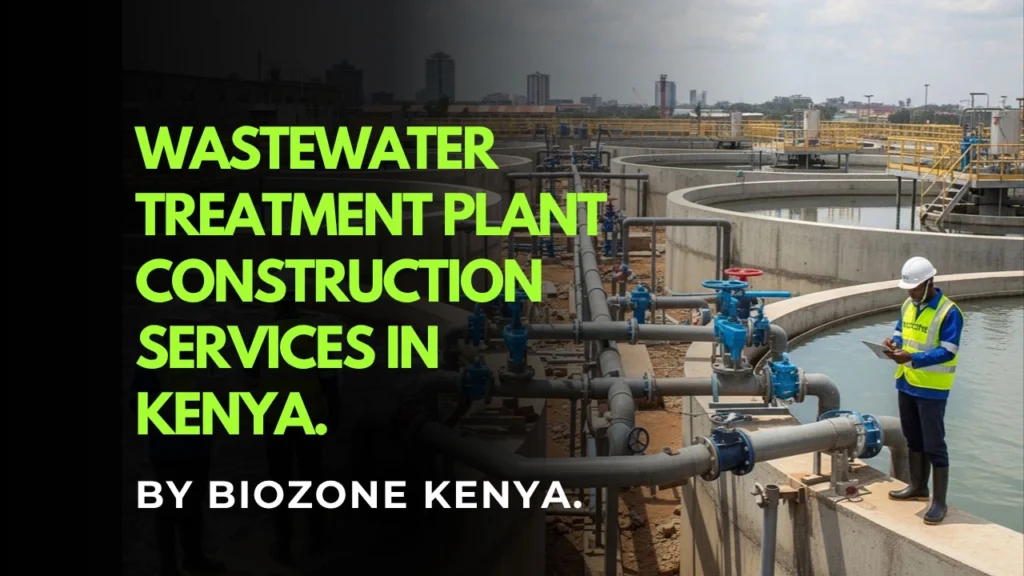
Wastewater treatment plant construction in Kenya has never been more urgent, or more commercially consequential. The National Environment Management Authority (NEMA) is enforcing water quality discharge regulations with unprecedented rigour, and facilities caught without compliant effluent management face heavy fines, legal action, and immediate closure notices.
Biozone, operating through Blueflame Energy Solutions Ltd, is one of Kenya’s leading wastewater treatment plant construction companies. We do not simply build tanks. We engineer complete, high-performance biological systems, then actively manage the microbial life inside them, to deliver treatment plants that meet NEMA standards, generate clean reusable water, produce biogas energy, and eliminate your dependence on expensive exhauster trucks.
This article covers everything you need to know about Biozone’s wastewater treatment plant construction in Kenya: the technology, the process, the industries we serve, and the biological science that makes Biozone systems consistently outperform those of conventional contractors.
What Is a Wastewater Treatment Plant and Why Does Kenya Need More of Them?
A wastewater treatment plant (WWTP) is an engineered facility that processes sewage, industrial effluent, or greywater through a sequence of physical, biological, and chemical treatment stages, transforming raw waste into effluent that is safe for discharge or reuse.
Kenya currently faces a critical shortage of compliant wastewater infrastructure. The gap between the volume of wastewater generated by Kenya’s growing urban, industrial, and institutional sectors and the capacity of existing treatment facilities is widening every year. The consequences are severe:
The Exhauster Dependency Trap: Thousands of Kenyan businesses and institutions still rely on vacuum exhauster trucks as their primary sewage management strategy. This is expensive, temporary, and frequently results in illegal dumping, creating serious environmental hazards, contaminating groundwater, and exposing facility owners to NEMA prosecution.
Tightening Regulation: Kenya’s Water Quality Regulations under the Environment Management and Coordination Act are being actively enforced. The Third Schedule of NEMA standards specifies precise limits on Biochemical Oxygen Demand (BOD), Chemical Oxygen Demand (COD), suspended solids, and pathogen levels in any discharged effluent. Failure to comply is not a minor administrative matter, it is a licence-threatening legal risk.
Infrastructure Failure: Traditional septic tanks were designed for a different era. They are failing under modern organic loads, from the high-BOD blood and fats of abattoirs to the chemical complexity of pharmaceutical effluent, dairy wastewater, and the sheer volume generated by high-density residential estates and boarding schools across Kenya.
The solution is not a bigger exhauster contract. It is proper wastewater treatment plant construction.
Biozone: Kenya’s Commercial and Industrial Wastewater Treatment Construction Company
Biozone was founded to address a gap that conventional contractors were not filling: the need for wastewater treatment systems that combine rigorous structural engineering with active biological management. We operate at the intersection of environmental engineering, biotechnology, and renewable energy.
We are one of the few commercial wastewater treatment companies in Kenya that both builds the plant and controls the biology inside it on an ongoing basis, giving our clients consistent, verifiable NEMA compliance rather than a one-time installation that degrades over time.
Our services span the full project lifecycle: consulting and laboratory analysis, tailored engineering design, turnkey construction and installation, biological commissioning, staff training, and long-term maintenance contracts. Whether you are a private developer constructing a new residential estate, a factory manager dealing with a NEMA compliance notice, a municipality with a failing oxidation lagoon, or a school looking to convert food and sanitation waste into biogas, Biozone engineers the right system for your specific situation.
We serve clients across all 47 counties of Kenya, deploying specialist engineering teams adapted to Nairobi’s high-density urban environment, the Coast’s salinity-sensitive conditions, arid Eastern and North Eastern regions, and the agricultural heartlands of the Rift Valley and Western regions.
The 5-Phase Wastewater Treatment Plant Construction Process
No two sites, waste profiles, or compliance requirements are identical. Biozone refuses a one-size-fits-all approach. Every wastewater treatment plant we construct follows this structured five-phase roadmap:
Phase 1: Diagnosis and Laboratory Analysis
Construction begins with science, not concrete. Our engineers collect samples from your inlet streams and any existing effluent and submit them for full laboratory analysis. We map the precise biological and chemical profile of your waste stream, BOD load, COD concentration, suspended solids, pathogen presence, pH range, and any industrial-specific contaminants (heavy metals, FOG, pharmaceutical compounds).
This diagnostic phase identifies exactly what your plant needs to achieve and why existing systems may be failing. It is the foundation of every technical decision that follows.
Phase 2: Tailored Engineering Design
Using advanced CAD modelling and biological process calculations, we design a wastewater treatment system optimised for your specific site footprint, daily flow volume, waste composition, and target effluent standard. We calculate the correct tank sizing, hydraulic retention times, aeration rates, and enzyme dosing schedules.
This phase also produces the documentation required for NEMA Environmental Impact Assessment (EIA) approval, a mandatory requirement for all new wastewater treatment plant construction projects in Kenya.
Phase 3: Construction and Installation
Our specialist construction crews deploy the physical infrastructure according to the approved engineering drawings. This includes excavation and civil works, tank construction (concrete or prefabricated), installation of blowers, aerators, fine-bubble diffusers, membranes, dosing pumps, UV disinfection units, gas storage systems, and PLC automation control panels.
We use high-durability, corrosion-resistant materials specified for the local environment, including salinity-resistant components for coastal installations and heat-tolerant anaerobic systems for North Eastern Kenya.
Phase 4: Commissioning and Biological Seeding
Commissioning is where most conventional contractors hand over the keys and leave. Biozone treats it as the most critical phase of the project. During plant startup, we introduce our proprietary Envirozyme BFB microbial formulations to establish a robust, active biological colony inside the treatment system.
This biological seeding process, using a concentrated blend of ten bacterial strains and hydrolytic enzymes, allows the plant to reach full treatment efficiency in a fraction of the time it would take for natural bacterial populations to establish. Your plant works properly from day one.
Phase 5: Managed Maintenance, Biological Dosing, and Training
A wastewater treatment plant is a living biological system. Its performance depends on maintaining a healthy, diverse microbial population, and that requires active, ongoing management. Biozone provides long-term maintenance contracts that include scheduled inspection visits, enzyme dosing replenishment, membrane servicing, drainage inspection, grease trap cleaning, sludge management, and effluent testing.
We also train your on-site staff to understand the system, monitor performance indicators, and respond correctly to operational issues, ensuring your team can maintain NEMA compliance independently between our visits.
Four Wastewater Treatment Plant Technologies Biozone Constructs in Kenya
Biozone specialises in four primary treatment plant categories. Selecting the right technology depends on your site’s land area, daily flow volume, waste composition, and desired effluent use.
1. Mechanical Biodigester Systems (MBR and SBR Plants)
Mechanical biodigesters using Membrane Bioreactor (MBR) and Sequencing Batch Reactor (SBR) technology represent the most advanced wastewater treatment plant construction option for high-density urban environments where land is limited.
How they work: MBR technology combines biological treatment with membrane filtration for wastewater treatment. Microorganisms break down organic waste in an aeration tank, and the effluent is then passed through ultrafiltration membranes that physically remove suspended solids, bacteria, and viruses, producing exceptionally high-quality treated water. SBR plants use a cyclic fill-and-draw process in which the same tank performs aeration and settling in sequential batches, achieving full carbon and nitrogen removal in a compact footprint.
Performance: Both systems achieve BOD reduction exceeding 95%, COD reduction exceeding 90%, and suspended solids removal exceeding 99%. The treated effluent meets NEMA discharge standards and is suitable for toilet flushing, landscape irrigation, or discharge to sensitive watercourses.
Ideal for: High-rise apartments and residential estates, shopping malls and commercial developments, hotels and hospitality facilities in Nairobi, Mombasa, and other urban centres, and any site where land for a lagoon system is not available.
Key components installed: Precision air blowers for wastewater treatment aeration, fine-bubble membrane diffusers, ultrafiltration membranes, dosing pumps, UV disinfection units, and PLC automation control systems.
MBR technology for wastewater treatment in Kenya is particularly well-suited to the high-density housing developments proliferating around Nairobi, where private developers need a compact, high-performance plant that can be buried beneath car parks or utility areas without odour complaints from residents.
2. Anaerobic Biodigesters (Waste-to-Energy Systems)
Anaerobic biodigesters are biological wastewater treatment and energy generation systems that break down high-strength organic waste in sealed, oxygen-free environments. Rather than treating waste as a disposal problem, they treat it as a fuel source.
How they work: In the absence of oxygen, anaerobic bacteria break down complex organic molecules, proteins, fats, carbohydrates, through a multi-stage process (hydrolysis → acidogenesis → acetogenesis → methanogenesis). The end products are biogas (primarily methane, CH₄), digested liquid effluent, and stabilised biosolids.
Technology options Biozone constructs:
- Red Mud PVC Flexible Digesters: Rapid to deploy, cost-effective for medium-scale institutional applications
- Concrete Fixed Dome Digesters: Permanent, high-capacity systems for large institutions, slaughterhouses, and agro-processing facilities
- Integrated gas storage balloons, purification systems, and pressure boosters for safe biogas utilisation
Performance: Up to 80% organic matter reduction, plus significant biogas production. A well-designed anaerobic digester at a 500-student boarding school, for example, can generate enough methane to meet a substantial portion of the kitchen’s daily cooking fuel requirements, permanently displacing charcoal or LPG costs.
Ideal for: Boarding schools and universities, slaughterhouses and abattoirs, dairy and agro-processing factories, flower farms, and any large institution generating high volumes of food or sanitation waste.
3. Lagoons and Oxidation Ponds (Biological Rehabilitation)
Oxidation lagoons and stabilisation ponds are land-intensive, low-energy biological treatment systems that use natural processes, sunlight, algae, bacteria, and retention time, to reduce pollutants in wastewater. They are the standard wastewater treatment approach for many Kenyan municipal utilities and rural water and sanitation companies (WASCOs).
While Biozone constructs new lagoon systems for clients with sufficient land, our most important work in this category is the biological rehabilitation of failing lagoons, and this is a major gap in Kenya’s wastewater management landscape.
Many existing municipal lagoons are failing NEMA inspections not because they need full reconstruction, but because they have become biologically inactive, choked with sludge, producing odours, and no longer achieving adequate treatment. Biozone’s Envirozyme BFB enzyme dosing programme restores biological activity without mechanical dredging or infrastructure rebuilding, returning lagoons to full NEMA compliance at a fraction of the cost of new construction.
Services we provide for lagoon systems:
- Full engineering design and construction of new oxidation lagoons and stabilisation ponds
- Biological rehabilitation of sludge-heavy, odour-producing, non-compliant lagoons
- Targeted enzyme dosing programmes to restore treatment efficiency
- Structural expansion and capacity upgrades for municipalities facing population growth
4. Septic Tank Bio-Retrofitting
Traditional septic tank systems remain the baseline sewage management infrastructure for millions of Kenyan homes and small commercial properties. The problem is that most of these systems are static, they accumulate sludge, emit hydrogen sulphide odours, cause soak pit failure, and require expensive, frequent exhauster visits.
Biozone converts static septic tanks into active biological digesters through our Bio-Retrofit service, introducing continuous enzyme and microbial dosing that activates the digestion process inside existing tanks, eliminating exhauster dependency, stopping odour problems, and preventing soak pit clogging. No reconstruction required.
For new builds, Biozone constructs the Biozone Biodigester Septic System, a significant upgrade over standard biodigester septics common in Kenya. Unlike the single-chamber, small-inspection-point systems that dominate the market, our system features:
- Four distinct chambers with adequate hydraulic retention time for full waste digestion
- Three large inspection points (450 × 600mm) for effective maintenance and monitoring
- Fixed Film Reactor (FFR) option for enhanced biological treatment under difficult loading conditions, including shock loads and flooding
Chemicals and Biological Additives for Wastewater Treatment in Kenya
One of the most significant and consistently misunderstood aspects of wastewater treatment plant management is the role of biological additives. Many facility managers ask about chemicals for wastewater treatment in Kenya, and while certain chemical dosing (chlorination, pH adjustment, coagulation) has its place in treatment processes, Biozone’s core biological philosophy centres on microbial and enzyme-based treatment rather than chemical intervention.
The right biological additives do not simply mask wastewater problems, they solve them at the molecular level by accelerating the natural decomposition processes that make wastewater treatment work.
Envirozyme BFB, The Metabolic Engine of Every Biozone Plant
Envirozyme BFB is Biozone’s flagship biological formulation for wastewater treatment. Understanding how it works explains why Biozone plants consistently outperform those built by conventional contractors using physical infrastructure alone.
What it is: A dry, free-flowing powder containing:
- Ten strains of natural bacteria, aerobic, anaerobic, and facultative species, including genera such as Pseudomonas, Alcaligenes, Achromobactin, Thiospirillum, and Rhodothecae. Because it contains both aerobic and anaerobic strains, it works regardless of whether the treatment environment has oxygen or not.
- Hydrolytic enzymes, including Protease (breaks down proteins), Amylase (breaks down starches), and Lipase (breaks down fats and oils)
Think of a wastewater treatment plant as a body. The tanks, pipes, blowers, and membranes are the skeleton and organs. Envirozyme BFB is the digestive system, the metabolic intelligence that processes incoming waste and produces clean outputs.
What it achieves in your plant:
| Function | Mechanism | Outcome |
| BOD & COD reduction | Bacteria consume organic compounds as food | Effluent meets NEMA Third Schedule standards |
| Sludge digestion | Enzymes break down accumulated solids | Reduced exhauster frequency or elimination |
| Odour control | Complete decomposition eliminates H₂S gas production | No community odour complaints |
| Shock load recovery | Microbial colony repopulates after chemical shock | System stability after bleach or disinfectant contamination |
| Faster commissioning | Pre-cultured colony establishes immediately | New plants reach full efficiency in days, not months |
| Water clarity | Solids-liquids separation is accelerated | Cleaner effluent suitable for reuse |
Where Envirozyme BFB is applied:
- Sewage treatment plants and mechanical wastewater treatment facilities
- Oxidation lagoons, stabilisation ponds, and oxidation pods
- Grease traps, dissolves fats, oils, and grease accumulation
- Septic tanks and biodigester septic systems
- Sludge pits and sludge drying beds
- Trickling filters (supporting Pseudomonas, Alcaligenes, and Flavobacterium biofilm growth)
- Anaerobic digesters, via the Biogas Booster BFB formulation for enhanced methane production
- Industrial effluent plants in food processing, textile, pharmaceutical, and agro-processing sectors
The recurring dosing model: Envirozyme BFB is not a one-time treatment. It is a managed biological maintenance programme. A typical installation begins with an initial seeding dose of approximately 100kg over the first seven days to establish the microbial colony, followed by a weekly maintenance dose of approximately 25kg to sustain optimal biological activity. This continuous biological management is what separates Biozone’s plants from those of contractors who install infrastructure and disappear.
Other Biozone Biological Formulations
Septozyme BFB: A specialist enzyme formulation using selected Bacilli strains that produce endospores under starvation, meaning biological activity persists even in intermittent-loading conditions or during periods of system stress. Applied in septic tanks and digestors to accelerate sludge breakdown and produce clearer effluent.
Biogas Booster BFB: An encapsulated Methanobacilli formulation that significantly increases methane production in anaerobic digesters. Contains facultative and anaerobic microbial consortia with a multi-enzyme blend. Produces enriched organic digestate, inactivates pathogens and parasites during digestion, and maximises the energy yield from biogas systems.
Bamoyeast BFB: A bacterial and enzyme formulation for the breakdown of solid organic matter, particularly toilet waste and food waste, in biodigester septics, pit latrines, and composting systems.
MBR Technology and Membrane Filtration for Wastewater Treatment in Kenya
Membrane filtration for wastewater treatment in Kenya represents a significant and growing segment of the country’s sanitation infrastructure investment, particularly among private developers, hospitality groups, and industrial facilities that require high-quality effluent for water recycling.
What makes MBR technology different from conventional biological treatment?
In a conventional activated sludge system, biological treatment and solids separation are performed in two separate stages, aeration first, then gravity settling in a clarifier. MBR technology combines both functions by replacing the clarifier with a membrane filtration unit. The membranes have pores of 0.04 to 0.4 microns, small enough to physically exclude all suspended solids, bacteria, and most viruses without chemical intervention.
The result is treated effluent of consistently higher quality than conventional systems can achieve, produced in a significantly smaller physical footprint. This makes MBR technology for wastewater treatment in Kenya particularly valuable in contexts where:
- Land is expensive (Nairobi CBD, Westlands, industrial parks)
- Effluent quality requirements are strict (discharge to sensitive watercourses, Class A reuse for irrigation)
- Space must be used flexibly (systems can be installed below ground level)
- Odour-sensitive neighbours require enclosed, odour-free operation
Biozone designs, supplies, and installs complete MBR wastewater treatment plant construction packages, including membrane modules, the precision air blowers for wastewater treatment aeration required to maintain membrane flux, automated backwash systems, and integration with downstream UV disinfection or reverse osmosis for potable reuse.
Wastewater Treatment Consulting in Kenya: Start with a Diagnosis
Before any wastewater treatment plant construction begins, Biozone recommends, and in most cases requires, a formal consulting and site assessment phase. Rushing into construction without accurate data about your waste stream is the single most common cause of plant underperformance and NEMA compliance failure.
As wastewater treatment consultants serving Kenya, our diagnostic process covers:
- Inlet characterisation: What is the volume, composition, and temporal variation of your wastewater? Daily flow rates, peak loads, BOD/COD ratios, and industrial contaminants must all be measured before engineering begins.
- Regulatory gap analysis: Which specific NEMA Third Schedule parameters is your current system failing to meet, and by how much?
- Technology selection: Given your site constraints, waste profile, budget, and required effluent standards, which treatment technology delivers the best long-term outcome?
- Resource recovery potential: Is biogas generation viable? Is water recycling economical? Can biosolids be valorised?
- EIA documentation: We prepare the full Environmental Impact Assessment submission required for NEMA approval of new wastewater treatment plant construction projects.
Our consulting process is the foundation of every wastewater treatment construction project we deliver, and it is also available as a standalone service for clients managing existing facilities who need an independent compliance audit or technology upgrade assessment.
Industries We Serve: Every Sector Has a Unique Wastewater Signature
Effective wastewater treatment plant construction requires deep understanding of what is actually in the wastewater. General-purpose systems fail when applied to specialist industrial effluent profiles. Biozone custom-engineers every plant to neutralise the specific pollutants generated by each client’s operations.
Slaughterhouses and Abattoirs
Abattoir wastewater is among the most challenging to treat in Kenya, characterised by extreme BOD loads from blood, high concentrations of fats, oils, and grease (FOG), elevated pathogen levels, and strong odour compounds. Standard domestic treatment systems fail catastrophically when applied to slaughterhouse effluent.
Biozone designs multi-stage treatment systems for slaughterhouses that combine mechanical screening (to capture hair, bone fragments, and large solids), grease trap pre-treatment with enzyme dosing, primary anaerobic digestion (capturing biogas from the high-energy organic content), secondary aerobic biological treatment, and UV disinfection for pathogen elimination.
Dairy and Agro-Processing
High-lactose dairy wastewater causes rapid oxygen depletion in receiving water bodies, a phenomenon known as eutrophication. Milk processing effluent also contains cleaning chemical residues, which interfere with biological treatment if not managed carefully. Biozone designs treatment systems that balance biological oxygen demand removal with pH stabilisation.
Horticulture and Flower Farms
Kenya’s floriculture sector, particularly in the Rift Valley and Central regions, generates effluent containing pesticide residues, fertiliser nitrates, and fungicide compounds that cannot be released to water bodies without treatment. Biozone engineers irrigation-reuse systems that treat flower farm effluent to the standard required for safe crop irrigation, turning a disposal liability into an agricultural water asset.
Textiles and Tanneries
Textile and tannery effluent contains toxic dyes, chromium and other heavy metals, and high concentrations of tannins that are inhibitory to biological treatment. Biozone applies specialist enzyme formulations capable of breaking down complex hydrocarbons and assists with the physical-chemical treatment steps (coagulation, precipitation) required to remove heavy metals before biological treatment.
Pharmaceutical and Laboratory Facilities
Active pharmaceutical ingredients (APIs) and laboratory chemical waste cannot be treated by standard biological systems alone, many of these compounds are specifically designed to resist biological degradation. Biozone designs hybrid treatment systems incorporating activated carbon adsorption and advanced oxidation processes alongside biological stages.
Commercial, Hospitality, and Tourism
Hotels, safari lodges, shopping malls, and commercial laundries require compact, odour-free, fully automated wastewater treatment systems that operate reliably without specialist on-site technical staff. Biozone’s modular MBR systems are particularly well-suited to this sector, delivering zero-odour operation, high-quality reusable effluent for landscape irrigation, and minimal maintenance requirements.
Schools, Universities, and Institutional Facilities
Large boarding schools and universities generate significant wastewater volumes from dormitories, kitchen operations, and food waste. Biozone designs integrated biogas systems that treat sewage and food waste simultaneously, producing methane for kitchen cooking and treated water for irrigation. Several Biozone institutional clients have completely eliminated their dependence on charcoal and firewood through this approach.
Municipalities and Water Utilities
Municipal wastewater treatment plant construction and rehabilitation is one of Biozone’s most impactful service areas. Many Kenyan Water and Sanitation Companies (WASCOs) operate ageing lagoon systems that are failing NEMA inspections. Biozone has rehabilitated several such systems through biological enzyme dosing programmes, restoring NEMA compliance without the cost and disruption of full infrastructure reconstruction.
Wastewater as a Resource: The Three Mining Outputs
Biozone operates on a philosophy that is fundamentally different from conventional wastewater contractors: wastewater is not a problem to be disposed of, it is a resource to be recovered.
Every compliant Biozone wastewater treatment plant is designed to extract maximum value from the waste stream through three recovery pathways:
Water Mining
A well-designed wastewater recycling plant can recover up to 90% of process wastewater, treating it to WHO non-potable reuse standards. Recovered water can be used for toilet flushing, agricultural irrigation, landscape maintenance, industrial process cooling, and dust suppression, reducing municipal water consumption and borehole depletion significantly.
For Kenyan clients in water-stressed counties, water recovery is not merely an environmental benefit, it is a direct operational cost saving that contributes materially to the return on investment of the treatment plant construction.
Energy Mining
Anaerobic digestion of organic waste generates methane, the same gas used in LPG. A Biozone-designed biogas system captures this methane before it enters the atmosphere (where it would act as a potent greenhouse gas) and delivers it as a practical fuel for commercial cooking, boiler heating, or electricity generation via a biogas-fuelled generator.
Institutions currently spending significant monthly budgets on charcoal, LPG, or diesel can substantially offset these costs through biogas capture from their own waste, turning a recurring expense into a partially self-funded energy supply.
Nutrient Mining
Digested biosolids, the semi-solid material remaining after biological treatment, are not waste. When properly processed, they are a high-nitrogen organic fertiliser that meets KEBS standards for agricultural application. For agro-processing clients, specific industrial waste streams (blood meal, bone meal) can be rendered into animal feed ingredients, creating a true zero-waste circular system.
Wastewater Treatment Plant Construction Across Kenya: Where We Work
Biozone deploys specialised engineering teams across all regions of Kenya, adapting our systems to local environmental conditions, regulatory contexts, and sector-specific requirements.
Nairobi Metropolitan Region: High-density urban sanitation, MBR and SBR mechanical biodigesters for apartments and commercial developments, and industrial effluent treatment for the Industrial Area, Ruaraka, and Ruai.
Central Region (Kiambu, Murang’a, Nyeri, Kirinyaga, Nyandarua): Institutional biogas systems for boarding schools, agricultural waste management for flower farms and dairy operations, and municipal lagoon rehabilitation for local WASCOs.
Rift Valley Region (Nakuru, Uasin Gishu, Kajiado, Laikipia, Narok, and surrounding counties): Slaughterhouse and abattoir stabilisation systems, large-scale anaerobic digesters for flower farms, and modular estate systems for expanding peri-urban developments.
Coast Region (Mombasa, Kilifi, Kwale, Lamu, Taita Taveta, Tana River): Salinity-resistant engineering, aerobic mechanical treatment plants for the hospitality and tourism sector, and compact systems for resort and lodge developments in ecologically sensitive coastal areas.
Lake Victoria and Western Region (Kisumu, Siaya, Homa Bay, Kakamega, and surrounding counties): Protecting the Lake Victoria water catchment through septic-to-biodigester retrofitting and industrial effluent treatment for agro-processing and fishing sector clients.
Eastern Region (Machakos, Makueni, Kitui, Embu, Meru, Tharaka Nithi, Isiolo, Marsabit): Arid-land water recovery systems designed to maximise effluent reuse for irrigation, and decentralised sanitation for rapidly urbanising county headquarters.
North Eastern Region (Garissa, Wajir, Mandera): Heat-resistant anaerobic digesters engineered for high ambient temperatures, robust low-maintenance lagoon systems, and decentralised sanitation infrastructure for remote communities.
Regulatory Compliance: NEMA, EPRA, and KEBS
Every Biozone wastewater treatment plant construction project is engineered to meet the full regulatory triple standard governing Kenya’s environmental and energy sectors.
NEMA Compliance (Environment Management and Coordination Act): We guarantee that all treated effluent meets the Third Schedule standards for Biochemical Oxygen Demand, Chemical Oxygen Demand, suspended solids, and pathogen levels. We prepare and submit the Environmental Impact Assessment (EIA) documentation required for plant construction approval, and we support clients through the process of obtaining and maintaining their NEMA Effluent Discharge Licence (EDL).
EPRA Certification (Energy and Petroleum Regulatory Authority): All biogas capture, compression, purification, pressure boosting, and storage systems installed by Biozone are engineered to EPRA safety standards. This is essential for any biogas plant used in commercial cooking, boiler applications, or electricity generation.
KEBS Standards (Kenya Bureau of Standards): Where Biozone systems produce recovered water for irrigation or treated biosolids for agricultural use, we assist clients in validating the safety and quality of these outputs against KEBS requirements.
The Economic Case for Wastewater Treatment Plant Construction
Wastewater treatment plant construction is not merely a regulatory compliance expenditure, it is an infrastructure investment with measurable financial returns. Biozone systems are specifically designed to generate returns across three financial dimensions:
Eliminating Exhauster Costs: For facilities currently spending KES 15,000 to KES 80,000 per exhauster visit, often monthly or more frequently, the elimination of this recurring cost alone can generate a substantial contribution to the plant’s capital cost recovery over its operational life.
Reducing Water Bills: A wastewater recycling plant recovering 80–90% of process water for toilet flushing and irrigation can reduce municipal water consumption materially, particularly for large institutional clients whose water bills are significant monthly operating costs.
Generating Energy Revenue: Biogas production from anaerobic digesters can eliminate or substantially reduce spending on cooking fuel. At institutional scale, boarding schools with 400+ students, food processing factories, the fuel cost offset can be economically transformative.
Avoiding Regulatory Penalties: The cost of NEMA fines, legal fees, and potential facility closure arising from non-compliant effluent discharge far exceeds the capital cost of proper treatment plant construction in almost every case.
Why Biozone: The Difference Between a Plant and a System
Most wastewater contractors operating in Kenya build infrastructure. Biozone builds biological systems, and then manages the biology inside them.
This distinction matters enormously for long-term performance. A treatment plant that is not biologically active, whether because the microbial population was never properly seeded, has been disrupted by chemical shock, or has simply been starved of the right bacterial species, will fail to achieve compliant effluent regardless of how well the tanks and pipes are built.
Biozone’s competitive advantage is threefold:
1. Biological Control: We actively manage the microbial life inside every plant we build through our proprietary Envirozyme BFB programme. Our plants maintain biological activity and treatment performance throughout their operational life, not just in the weeks following commissioning.
2. Full Lifecycle Partnership: We do not disappear after installation. Our managed maintenance contracts, recurring biological dosing programmes, and ongoing compliance monitoring mean that Biozone clients maintain NEMA compliance without having to source, coordinate, and manage multiple separate contractors for different aspects of plant operation.
3. Resource Recovery Philosophy: We design every plant with resource recovery in mind from the first engineering drawing. Water, energy, and nutrients are embedded in the system architecture, not retrofitted as afterthoughts. This means our clients do not just achieve compliance; they achieve compliance while generating economic value from their waste.
Get Started: Wastewater Treatment Plant Construction Assessment
If you are dealing with a NEMA compliance notice, planning a new development and need to design wastewater treatment infrastructure, managing a failing plant that is no longer meeting discharge standards, or exploring whether wastewater-to-energy conversion is viable for your facility, Biozone’s engineering team is ready to assess your situation.
We offer a free initial site assessment for qualifying projects across Kenya.
Contact Biozone / Blueflame Energy Solutions Ltd:
- Phone (Kenya): 0111 715 578
- Phone (International): +254 111 715 578
- Email: info@biozone.co.ke
- Website: www.biozone.co.ke
Our engineers serve clients from Mombasa to Mandera, Nairobi to Nakuru, and every county in between. Contact us today to discuss your wastewater treatment plant construction requirements.
Frequently Asked Questions
What is the minimum size of wastewater treatment plant Biozone constructs?
We design and construct systems from 4,000 litres (suitable for small homes and commercial properties) upward to large industrial and municipal plants serving tens of thousands of people. We also offer small wastewater treatment plants for home use through our biodigester septic range.
Does my new development require NEMA approval for wastewater treatment plant construction?
Yes. All new wastewater treatment plant construction projects in Kenya require an Environmental Impact Assessment (EIA) and NEMA approval before construction begins. Biozone manages this documentation process as part of our design service.
Can Biozone fix a failing plant without rebuilding it completely?
In many cases, yes. Biological rehabilitation through Envirozyme BFB enzyme dosing can restore treatment performance in failing lagoons and biodigesters without structural reconstruction. We assess every failing plant individually before recommending either rehabilitation or rebuilding.
What chemicals does Biozone use in wastewater treatment?
Biozone’s primary treatment approach uses biological additives, microbial cultures and enzymes, rather than industrial chemicals. Our Envirozyme BFB formulation is natural, non-toxic, and environmentally safe. Certain applications (pH adjustment, disinfection) may incorporate approved chemical treatments, but these are secondary to the biological process.
How long does wastewater treatment plant construction take?
Construction timelines depend on plant scale and complexity. Packaged biodigester septic systems can be installed in days. Industrial wastewater treatment plant construction for large facilities typically takes four to twelve weeks from design finalisation to commissioning, depending on civil works complexity.
Do you provide wastewater treatment services after construction?
Yes. Biozone’s managed maintenance contracts include scheduled inspection visits, biological dosing replenishment, membrane servicing, staff retraining, and ongoing effluent testing to ensure continuous NEMA compliance throughout the plant’s operational life.
Biozone is a trading name of Blueflame Energy Solutions Ltd, registered in Kenya. We are commercial and industrial wastewater treatment plant construction companies operating across all 47 counties. All plants are designed to meet NEMA, EPRA, and KEBS regulatory standards.