

NEMA-Compliant Systems. No Exhauster Trucks. Reusable Effluent.
★★★★★ 5.0 Rating: 215 Google Reviews | 4,000+ Projects Delivered | 10+ Years in Kenya | Verified BOD Output: 11 mg/L
No sewer connection in Nakuru? Facing NEMA enforcement pressure? Whether you are developing a residential estate, managing a hospital, running a hotel on the shores of Lake Naivasha, or operating a flower farm or dairy plant: Biozone engineers a compliant, low-maintenance wastewater treatment system designed for your exact site and conditions in Nakuru County.
Biozone, the trading name of Blueflame Energy Solutions Ltd, has designed and constructed wastewater treatment plants in Nakuru and across all 47 counties of Kenya since 2015. Founded by Henry Chochu, an aeronautical engineering graduate, the company has delivered over 4,000 wastewater projects for residential, commercial, industrial, and institutional clients. Biozone’s biological treatment systems achieve a verified BOD output of 11 mg/litre and Ammoniacal Nitrogen of 7 mg/litre: meeting and exceeding Kenya’s National Environment Management Authority (NEMA) effluent discharge standards. For the full scope of Biozone’s wastewater treatment plant construction services across Kenya, visit our national service page.
- ✓ A system sized and engineered for your specific Nakuru site, daily flow, soil conditions, and terrain: not an off-the-shelf package
- ✓ Full NEMA and EIA compliance: from discharge licence application to approved, commissioned installation
- ✓ Verified effluent quality: BOD 11 mg/L: suitable for irrigation, toilet flushing, or safe discharge to Nakuru’s rivers and water courses
- ✓ End-to-end service: feasibility assessment, engineering design, civil construction, commissioning, and long-term maintenance under one provider
- ✓ site assessment: prompt response from our engineers
Get Your Site Assessment Call or WhatsApp: +254 111 715 578

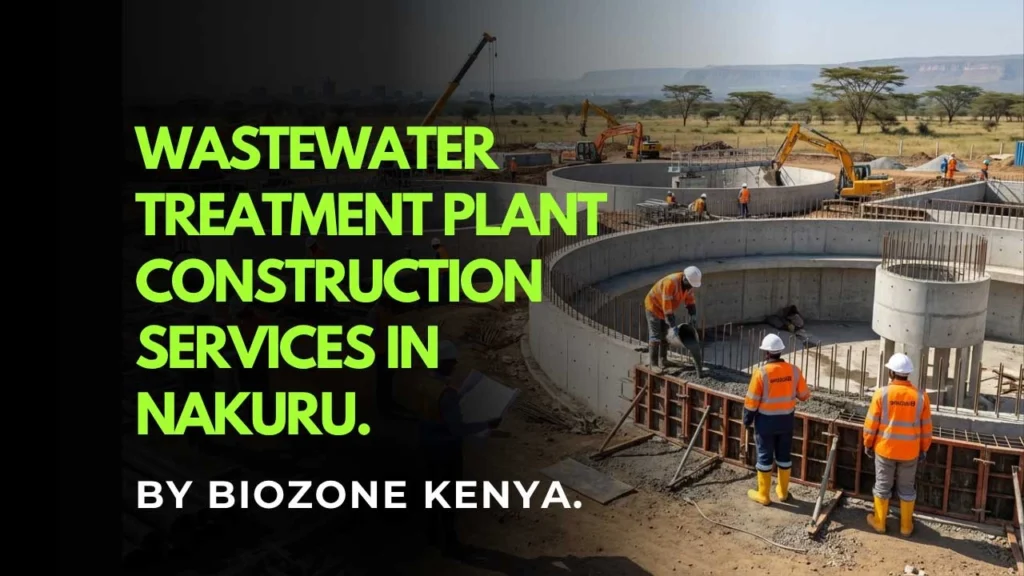
The Nakuru Wastewater Challenge
Nakuru County is home to Kenya’s fourth-largest city and one of the country’s fastest-growing urban economies. Yet despite rapid population growth: with the county now exceeding 2.2 million residents: the sewerage infrastructure serving Nakuru City reaches only a fraction of the population.
According to the County Government of Nakuru, only a handful of established estates: among them Milimani, Langa Langa, London, the Town Centre, Racecourse, and Freehold: are connected to the municipal sewer network. The vast majority of residential developments, commercial premises, hotels, schools, hospitals, and industrial facilities across Nakuru City, Naivasha, Gilgil, Molo, Njoro, and Rongai rely on septic tanks, pit latrines, and exhauster trucks to manage wastewater.
This creates an acute compliance risk. NEMA’s Water Quality Regulations require that all effluent discharged to land, waterways, or storm drainage meets prescribed quality standards. For facilities near Lake Nakuru: a Ramsar-listed wetland and national park: and Lake Naivasha: Kenya’s most productive freshwater ecosystem and the heart of the county’s floriculture industry: the environmental consequences of untreated effluent are significant. Contamination of these ecologically sensitive water bodies threatens not only biodiversity but the tourism and export agriculture industries upon which Nakuru’s economy depends.
A purpose-built wastewater treatment plant construction in Nakuru is the only reliable, compliant, and long-term solution for properties and facilities that sit beyond the reach of the municipal sewer. For tailored guidance, consult Biozone’s wastewater treatment consultancy team before beginning any project.
Who Needs a Wastewater Treatment Plant in Nakuru?
Residential Developments
Nakuru’s residential growth is concentrated in areas such as Milimani Phase 2, Lakeview Estate, London Estate extensions, Pipeline, Flamingo Estate, Free Area, and rapidly developing satellite zones including Lanet, Ngata, Rhonda, and Salgaa. The majority of these areas lie beyond the sewer network. Apartment developers, gated community managers, and private homeowners in these zones face mounting NEMA enforcement pressure and the recurring operational cost of exhauster trucks. A sewage water recycling system purpose-built for the site’s population equivalent eliminates exhauster dependency permanently and produces treated effluent suitable for irrigation or safe ground discharge.
Commercial Properties
Nakuru City’s growing commercial district: including hotels, malls, restaurants, petrol stations, and office complexes along Kenyatta Avenue, Gusii Road, and the expanding Westside Mall area: generates significant daily wastewater volumes. Commercial properties face stricter NEMA scrutiny and higher effluent loads than domestic users. Biozone designs mechanical treatment systems scaled to commercial daily flows, with gravity or pumped outlet options suitable for the relatively flat terrain of Nakuru’s urban core.
Industrial Facilities
Nakuru’s Industrial Area along Muhotetu Road hosts manufacturing, food processing, and agro-processing plants that generate high-BOD industrial effluent requiring treatment before discharge. Flower farms around Naivasha’s lake basin, dairy processing plants, and pyrethrum processing operations each produce effluent with unique characteristics: high organic loads, nutrient levels, and sometimes chemical content: that standard septic systems cannot treat. NEMA’s industrial effluent standards are significantly stricter than domestic standards, and non-compliance carries substantial penalties including facility shutdown.
Institutions
Nakuru County hosts Egerton University’s main campus at Njoro, Nakuru Town Campus College, the Nakuru County Referral and Teaching Hospital (Level 6, 1,129 beds), War Memorial Hospital, multiple polytechnics, and hundreds of primary and secondary schools: many of which are boarding facilities generating continuous wastewater flows. Large institutional populations require robust, consistently performing treatment systems, and the consequences of system failure: for health compliance and NEMA licence conditions: are severe. Biozone’s institutional systems are designed for continuous operation with minimal manual intervention.
Wastewater Treatment Plant Construction Services in Nakuru: By Client Type
Wastewater Treatment Plant Construction for Residential Apartments and Estates in Nakuru
Nakuru’s residential apartment market is expanding rapidly, particularly in neighbourhoods like Pipeline, Rhonda, and Lanet where multi-storey developments are rising beyond the reach of the city’s sewer network. Residential apartment blocks typically generate 150: 250 litres of wastewater per person per day, creating significant volumes even for medium-sized developments of 50: 200 units.
Without connection to the municipal sewer, these developments face a choice between continuous, costly exhauster truck services or a properly engineered on-site treatment plant. Biozone’s SBR and ASBR systems are designed specifically for high-density residential loads in Nakuru’s varied soil conditions, producing treated effluent with BOD at 11 mg/litre: clean enough for landscape irrigation within the estate. The minimum site footprint from 2 sq m makes these systems viable even on constrained urban plots.
Wastewater Treatment Plant Construction for Hotels and Lodges in Nakuru
Nakuru County’s tourism economy revolves around two water bodies: Lake Nakuru and Lake Naivasha. Hotels and lodges lining the shores of Lake Naivasha: including those in Kongoni, South Lake Road, and the Naivasha township: operate within one of Kenya’s most ecologically monitored catchment areas. NEMA and the Water Resources Authority (WRA) enforce strict discharge controls for any facility near the lake.
Biozone designs hotel wastewater systems that treat effluent to reuse quality: suitable for garden irrigation and non-potable building services: thereby eliminating both exhauster dependency and the environmental liability of inadequately treated discharge near a sensitive water body. For city hotels in Nakuru’s central business district and growing hospitality zone along Kenyatta Avenue, Biozone’s compact systems with minimum footprint from 2 sq m integrate into existing building infrastructure without requiring major civil works.
Wastewater Treatment Plant Construction for Hospitals and Health Centres in Nakuru
The Nakuru County Referral and Teaching Hospital is a 1,129-bed Level 6 facility generating hospital wastewater with a particularly challenging effluent profile: pharmaceutical residues, pathogenic microorganisms, heavy organic loads, and disinfectant chemicals that overwhelm standard biological treatment unless properly designed for.
Nakuru County’s 648 health facilities: spanning government, faith-based, private, and NGO facilities across all 11 constituencies: face NEMA obligations specific to healthcare effluent. Biozone’s hospital wastewater treatment systems incorporate tertiary disinfection stages including UV treatment and chlorination to neutralise pathogens, meeting the Water Quality Regulations’ healthcare effluent standards. A properly designed, maintained hospital WWTP also reduces the reputational and legal risk of a healthcare facility being found in breach of environmental law.
Wastewater Treatment Plant Construction for Schools and Universities in Nakuru
Egerton University’s main campus at Njoro accommodates thousands of students, academic staff, and support personnel, generating continuous high-volume wastewater flows throughout the academic calendar. Nakuru County’s numerous boarding secondary schools: clustered in constituencies such as Molo, Njoro, Bahati, Kuresoi South, and Subukia: face similar challenges: large dormitory populations, communal kitchen and laundry wastewater, and sites that typically lie in rural or peri-urban areas beyond municipal sewer reach.
Biozone designs school and university WWTP systems that operate reliably during term time’s peak flows and continue functioning safely: with Biozone’s sludge return facility feature: during holiday periods when occupancy drops significantly.
Wastewater Treatment Plant Construction for Flower Farms and Floriculture Operations in Nakuru
Nakuru County’s floriculture industry generated over KSh 23 billion in 2023, with the majority of production concentrated around Lake Naivasha’s shores. Flower farm wastewater: including irrigation runoff, grading room effluent, pesticide residues, and worker facilities wastewater: presents a complex treatment challenge.
Export market sustainability requirements from buyers in Europe and the Middle East increasingly require documented effluent management compliance, and the proximity of Naivasha flower farms to the lake means NEMA and WRA maintain particularly close scrutiny of discharge quality. Biozone designs flower farm wastewater treatment systems that address the full effluent stream, from staff facilities to processing and post-harvest operations, producing treated water suitable for controlled reuse in irrigation: reducing both freshwater abstraction and the risk of lake contamination.
Wastewater Treatment Plant Construction for Dairy Creameries and Milk Processing Factories in Nakuru
Nakuru County produces 318 million litres of milk annually, supporting dairy cooperatives, creameries, and milk processing factories across Molo, Njoro, Subukia, Rongai, and Naivasha. Dairy processing effluent is among the highest-BOD wastewater streams in the food industry: with BOD values often exceeding 2,000 mg/litre from milk solids, whey, cleaning agents, and chemical-in-place (CIP) wash waters. Standard septic systems are entirely inadequate for dairy effluent of this strength.
Biozone’s activated sludge and MBBR systems are designed to manage the high organic loading of dairy processing plants, reducing BOD to compliant discharge levels and producing treated water potentially suitable for on-site reuse in cleaning or irrigation. NEMA’s food industry effluent standards require dairy facilities to demonstrate ongoing treatment performance: something only a properly commissioned plant with regular maintenance can guarantee.
Wastewater Treatment Plant Construction for Geothermal Facilities in Nakuru
Nakuru County is home to the Olkaria Geothermal Plant in Naivasha: one of Africa’s largest geothermal power installations. Geothermal facilities generate a range of industrial wastewater streams including cooling water, chemical treatment blowdown, staff facilities effluent, and maintenance workshop drainage. The proximity of Olkaria to Lake Naivasha’s sensitive ecosystem places these facilities under strict NEMA and WRA oversight. Biozone provides wastewater treatment consultancy and system design for industrial and energy facilities in Nakuru, drawing on its experience across Kenya’s industrial sector to specify compliant treatment solutions for complex multi-stream effluent challenges.
Wastewater Treatment Plant Construction for Pyrethrum Processing Plants in Nakuru
Nakuru County is Kenya’s leading pyrethrum producer, with the crop grown across eight sub-counties including Molo, Kuresoi North, Kuresoi South, Njoro, Gilgil, Naivasha, Bahati, and Subukia. The Kentegra Ltd processing factory: the first major pyrethrum processing investment in the county: marks the beginning of a value-addition phase that will require compliant industrial wastewater treatment. Pyrethrum processing generates effluent containing plant material, solvent residues from extraction, and high-strength organic loads. Biozone’s engineering consultancy team can design bespoke treatment systems for agro-processing plants, ensuring NEMA compliance from the outset of the processing operation.
Wastewater Treatment Plant Construction for Industrial Manufacturing Plants in Nakuru
Nakuru’s Industrial Area along Muhotetu Road and surrounding zones hosts manufacturing and processing operations producing diverse industrial effluent streams. Whether the effluent comes from food processing, metal fabrication, chemical blending, or packaging operations, the common requirement is a treatment system that reduces BOD, suspended solids, and specific contaminants to NEMA-compliant discharge levels before any effluent reaches ground, storm drainage, or waterways. Biozone’s industrial WWTP designs begin with wastewater characterisation: sampling and analysing the specific effluent stream: before any technology is selected, ensuring the plant is matched to the actual effluent rather than a generic specification.
Wastewater Treatment Plant Construction for Construction Sites in Nakuru
Nakuru County’s rapid development: spanning new residential estates in Lanet and Ngata, commercial developments along the bypass, and large-scale infrastructure projects: creates temporary but significant wastewater management challenges on active construction sites. Biozone’s mobile and portable WWTP systems are designed precisely for this application: deployable on-site for the duration of construction, compliant with NEMA site sanitation requirements, and removable upon project completion. Mobile systems are available in configurations from small contractor camps to large multi-phase development sites accommodating hundreds of workers.
Wastewater Treatment Plant Construction for Slaughterhouses and Abattoirs in Nakuru
Slaughterhouse and abattoir wastewater is among the most challenging effluent streams in the food industry: high in blood, fats, proteins, pathogens, and suspended solids, with BOD values that can reach 10,000 mg/litre or more. Nakuru County’s active livestock economy, centred on cattle and smallstock in constituencies including Rongai, Molo, and Bahati, supports several abattoirs and slaughter facilities that are subject to strict NEMA food processing effluent standards. Biozone designs slaughterhouse treatment systems incorporating primary screening and dissolved air flotation (DAF) for fats and solids removal, followed by biological treatment to meet discharge standards.
Biozone’s Full Lifecycle WWTP Services in Nakuru
Unlike equipment suppliers who deliver a packaged plant and leave, Biozone provides end-to-end project ownership: from initial site survey and hydraulic design, through civil construction and biological commissioning, to long-term maintenance and regulatory support. Biozone’s ASBR and SBR systems are engineered in-house, not rebranded imports, and the company applies its own biological enzymes and microbial cultures to maintain treatment performance after handover.
Feasibility and Site Assessment
Every Biozone project begins with a site visit to Nakuru by our engineering team. We assess daily flow rates, population equivalent, topography, soil permeability, proximity to water courses or sensitive zones, available land area, and power supply. For sites near Lake Nakuru or Lake Naivasha, we factor in the specific NEMA catchment requirements that apply to those sensitive zones. This assessment shapes the entire design: no two Nakuru sites are identical, and no two Biozone systems are identical.
Engineering Design
Following site assessment, Biozone produces full hydraulic design documents, technology selection rationale, engineering drawings, and a detailed Bill of Quantities (BOQ). For projects requiring NEMA Environmental Impact Assessment (EIA), Biozone’s consultancy team prepares the EIA documentation and manages the submission and approval process through to discharge licence issuance.
Construction and Civil Works
Biozone constructs all civil structures: tanks, chambers, blower housings, and access infrastructure: to the Ministry of Water and Irrigation guidelines (December 2008 edition), using reinforced concrete with approved waterproofing membranes, correct curing periods of 21 days for structural elements and 14 days for formwork, and watertight construction throughout. Nakuru’s Rift Valley terrain: ranging from the flat lake basin around Naivasha to the undulating highland soils of Molo and Njoro: requires site-specific civil solutions that Biozone’s experienced construction teams are equipped to deliver.
Equipment Supply and Installation
Biozone supplies and installs the full complement of wastewater treatment appliances and equipment including air blowers, fine bubble diffusers, UV disinfection units, dosing pumps, chemical storage tanks, filtration media, and control panels. Where relevant, Biozone’s biological water recycling solution: Envirozyme BFB: is applied to maintain biological activity and treatment performance after commissioning.
Commissioning, Testing and Operator Training
Biological startup: seeding the system with active microbial cultures and bringing the treatment process to full performance: is a critical phase that many contractors skip. Biozone’s commissioning process includes biological startup monitoring, effluent sampling and analysis, performance testing against NEMA standards, and operator training to ensure site staff can maintain the system correctly.
Operations and Maintenance
Biozone offers scheduled maintenance programmes for all installed systems in Nakuru County, covering regular inspection, blower and diffuser servicing, sludge monitoring and removal scheduling, enzyme and microbial culture applications, and emergency call-out support. Our biodigester maintenance and rehabilitation team also rehabilitates existing systems that have underperformed or been incorrectly installed by other contractors.
How Wastewater Treatment Works
Understanding the treatment process helps property owners, developers, and facility managers make informed decisions when selecting a system for their Nakuru site. What follows is a plain-English explanation of the stages Biozone’s systems use to convert raw sewage into safe, reusable water.
Preliminary Treatment
Raw wastewater entering the treatment plant passes through coarse and fine screens that remove large solids: rags, plastics, grit, and debris: that would otherwise damage downstream equipment. In high-flow systems, a grit channel further removes sand and inorganic particles. This stage protects the biological treatment zones and reduces maintenance burden.
Primary Treatment
Wastewater flows into a primary sedimentation tank or settlement chamber where gravity separates settleable suspended solids: primary sludge: and floatable materials from the liquid stream. Primary treatment removes 50: 70% of suspended solids and 25: 40% of BOD from the incoming flow. However, it does not address dissolved organic matter, nitrogen, or phosphorus: which require the biological secondary stage for removal.
Secondary Treatment: Biological Wastewater Treatment
Biological wastewater treatment is the core of any modern treatment system and the stage where Biozone’s in-house ASBR and SBR technologies deliver their verified performance. In the aeration zone, a diverse community of microorganisms: predominantly bacteria: consume dissolved organic matter in the wastewater as their food source, converting it into biomass, carbon dioxide, and water. This is activated sludge treatment: the microorganisms are maintained in suspension in the mixed liquor by continuous aeration, with Return Activated Sludge (RAS) recycled back to the aeration tank and Waste Activated Sludge (WAS) periodically removed for sludge management.
At the heart of Biozone’s secondary treatment performance is the two-stage nitrogen removal process. Nitrification occurs under aerobic conditions: ammonia in the wastewater is oxidised first to nitrite by Nitrosomonas bacteria, then to nitrate by Nitrobacter bacteria. Denitrification follows under anoxic conditions, converting nitrate to nitrogen gas, which escapes harmlessly to atmosphere. The combined effect is near-complete nitrogen removal from the treated effluent: achieving Biozone’s confirmed Ammoniacal Nitrogen output of 7 mg/litre. BOD removal through this biological process achieves Biozone’s verified BOD output of 11 mg/litre: well within NEMA’s discharge standards and fully consistent with the WHO guidelines on wastewater reuse for restricted irrigation.
Tertiary Treatment
For applications requiring the highest effluent quality: including sites near Lake Naivasha or Lake Nakuru, or where treated water is to be reused for toilet flushing or non-potable building services: Biozone adds a tertiary polishing stage. This typically involves multimedia filtration to remove residual suspended solids, followed by UV disinfection or chlorination to inactivate any remaining pathogens, and where required, nutrient polishing to reduce phosphorus to NEMA consent levels.
Effluent Disposal and Reuse
Biozone’s treated effluent: clear, odourless, and with BOD at 11 mg/litre: can be safely discharged to a watercourse with appropriate WRA consent, applied to land for restricted irrigation, used for toilet flushing and non-potable building services within the property, or infiltrated to groundwater via a soakage trench. For Nakuru sites in the Lake Naivasha catchment, treated water reuse for irrigation represents both an environmental benefit and a reduction in freshwater abstraction from the already-stressed lake.
Planning and Design Considerations for Nakuru County
Getting the design right before construction begins is the single most important factor in a WWTP’s long-term performance. A plant undersized for its actual population equivalent will fail within months. A plant built with the wrong technology for its effluent type will never meet NEMA standards regardless of how well it is operated.
For Nakuru County, specific design considerations include flow rates and population equivalent (PE): the hydraulic calculation that determines tank sizing. Residential estates use 150: 200 litres per person per day. Hotels use 250: 350 litres per bed. Hospitals use 350: 450 litres per bed. Getting PE right is non-negotiable.
Decentralised wastewater treatment is the appropriate approach for most of Nakuru’s developments: individual property-level or estate-level systems rather than reliance on a centrally extended municipal sewer that may never reach many areas. Modular wastewater treatment plant designs allow phased development projects to start with a plant sized for Phase 1 and expand as occupancy increases, avoiding the capital cost of oversizing at the outset. For the Naivasha lakeside zone, NEMA’s EIA requirement is triggered for any facility likely to discharge effluent to or near the lake: and Biozone’s consultancy team handles the full EIA documentation and submission process.
Cost of Wastewater Treatment Plant Construction in Nakuru
What Determines the Cost
The cost of wastewater treatment plant construction in Nakuru is determined by several project-specific factors, not by a fixed price list. Understanding these factors helps property owners and developers evaluate and compare quotations accurately.
Flow capacity is the primary cost driver. A system treating 10 m³ per day: suitable for a small estate or guesthouse: requires significantly less civil works, equipment, and electrical infrastructure than a system treating 200 m³ per day for a large residential development or hospital. Treatment technology selection also significantly affects cost: an MBR system delivering the highest effluent quality occupies the smallest footprint but carries the highest capital and energy cost, while an SBR or activated sludge system at the same capacity has lower capital cost but requires more land.
Site conditions specific to Nakuru affect civil works cost significantly. The flat lakebed soils around Naivasha have different foundation requirements from the volcanic soils of Njoro and the hillside terrain of Molo and Kuresoi. Rocky ground, high water tables near Naivasha’s lake shore, and sloping sites all add to civil complexity. Industrial vs domestic loading is another major variable: treating dairy effluent with BOD of 2,000 mg/litre requires a fundamentally different and more expensive system than treating domestic effluent with BOD of 300 mg/litre, even if the daily flow volume is the same.
CAPEX vs OPEX: Total Cost of Ownership
The full cost of a wastewater treatment plant spans the initial capital expenditure (CAPEX): feasibility, design, civil construction, equipment supply and installation, and commissioning: and the ongoing operational expenditure (OPEX): electricity for aeration blowers, treatment chemicals, sludge removal, scheduled maintenance, and operator labour. A critical insight that separates well-designed from poorly designed systems is that choosing the lowest CAPEX option almost invariably produces the highest OPEX. A plant incorrectly sized or poorly constructed will require more energy, more chemical dosing, more frequent maintenance, and eventually rehabilitation: at a total lifetime cost far exceeding the saving on initial capital.
Why Quotations Vary Widely
A quotation that appears significantly lower than others almost always reflects a narrower scope: omitting NEMA documentation, using substandard civil construction, undersizing the system for the actual population, or supplying unserviceable imported equipment without local support. Biozone’s post-site-assessment quotations are detailed and itemised, covering every phase from feasibility to commissioning, so clients can compare accurately. Visit https://www.biozone.co.ke/contact/ and submit your project details: our engineers will respond with the correct, itemised cost for your specific Nakuru site and requirements.
Technology Comparison: Choosing the Right System for Your Nakuru Site
| Technology | Best For | Key Advantage | Limitation |
|---|---|---|---|
| Activated Sludge | Medium: large municipal/industrial | Proven, flexible, cost-effective at scale | Larger land footprint |
| ASBR: BZM Fix Model | Large communities; full C&N removal | Odour-free, reuse-quality effluent; robust | Requires consistent power |
| SBR: BZM Model | Variable flows; residential to large-scale | Full C&N removal; reuse-quality effluent | Batch process; timing-sensitive |
| MBR (Membrane Bioreactor) | Space-constrained sites; highest quality | Most compact; superior effluent quality | Highest CAPEX and energy cost |
| MBBR (Moving Bed Biofilm Reactor) | Upgrades; variable/industrial loads | Flexible; robust to load variation | May need polishing step |
| Modular / Packaged Plants | Remote/phased sites; construction sites | Fast deployment; scalable | Higher unit cost at scale |
For most residential estates and hotels in Nakuru City and Naivasha, Biozone’s SBR (BZM Model) delivers the best balance of performance, footprint, and total cost of ownership: handling the variable daily flows typical of occupied buildings while achieving full carbon and nitrogen removal. For large-scale developments, hospitals, or industrial facilities with more consistent high flows, the ASBR (BZM Fix Model) offers the most robust performance with odour-free operation and reuse-quality effluent.
For flower farms and dairy plants in Nakuru where effluent characteristics deviate significantly from domestic wastewater, Biozone conducts wastewater characterisation: sampling and laboratory analysis: before technology selection. As referenced in the EPA technical overview of MBBR systems, moving bed biofilm reactors are particularly effective for industrial effluent streams with variable organic loading: a profile common in Nakuru’s agro-processing sector. Biozone’s specialist wastewater enzymes and microbes can be applied to any technology to enhance biological performance and maintain treatment efficiency. For projects that may benefit from a biodigester septic tank at the smaller end of the scale, Biozone’s biodigester range starts from 4,000 litres capacity.
Sludge Management in Nakuru County
Every wastewater treatment plant produces sludge: the concentrated biological solids separated from the treated effluent: and managing that sludge correctly is both a compliance requirement and an operational necessity. In Nakuru, sludge from residential and institutional systems is typically thickened within the system before periodic removal. Biozone’s installed systems include a sludge return facility that recycles settled biomass back to the aeration zone, supporting denitrification and maintaining biological activity during extended periods of low occupancy: including school holidays and hotel off-seasons that are common across Nakuru County.
For dairy and agro-processing plants in Nakuru, sludge volumes and organic content are substantially higher than domestic systems. Biozone designs sludge dewatering provisions: including sludge drying beds or mechanical dewatering options: appropriate to the facility’s sludge production rate. Dewatered sludge from non-industrial domestic systems can typically be applied to agricultural land as a soil conditioner under NEMA guidelines, which is particularly relevant in Nakuru’s extensive farming areas. For Nakuru sites near Lake Nakuru or Lake Naivasha, NEMA requires that sludge disposal does not contaminate catchment soils or groundwater, and Biozone’s maintenance programmes include sludge disposal documentation for regulatory compliance purposes.
Common WWTP Challenges and How Biozone Prevents Them
Undersized systems are the single most common cause of treatment failure in Kenya. Biozone prevents this through rigorous site surveys and hydraulic calculations: based on actual measured flows and realistic population equivalents: before any design is finalised.
Technology mismatch occurs when a system designed for domestic effluent is installed to treat industrial wastewater, or vice versa. Biozone prevents this through wastewater characterisation: laboratory analysis of the actual effluent: before technology selection. No Biozone system is specified until the effluent composition is confirmed.
Poor civil construction: cracked tanks, inadequate waterproofing, premature formwork removal: creates leaking systems that contaminate groundwater and fail NEMA inspection. Biozone’s construction adheres to the Ministry of Water and Irrigation guidelines, using approved waterproofing membranes, correct concrete mixes, and verified curing periods.
No commissioning means installing a biological treatment plant and simply switching it on without the biological startup phase that seeds the system with active microbial communities. A plant that bypasses commissioning will not perform to design specification for weeks or months. Biozone’s commissioning process is a defined, documented phase with performance testing before handover.
No maintenance plan means a system that performs well at commissioning will degrade steadily over time as equipment wears, diffusers clog, and biological populations are disrupted. Biozone’s scheduled maintenance programmes prevent degradation and maintain NEMA compliance throughout the system’s operational life. View projects we have completed to see the standard of installation and system quality Biozone delivers.
Regulatory Compliance for WWTP Construction in Nakuru County
Any facility discharging or disposing of wastewater in Nakuru County must comply with Kenya’s environmental and water regulatory framework. Non-compliance carries consequences including facility closure, financial penalties, remediation costs, and reputational damage.
The National Environment Management Authority (NEMA) enforces the Water Quality Regulations 2006, which specify maximum permissible limits for BOD, suspended solids, pH, nitrogen, and other parameters in effluent discharged to land or water. Any WWTP project that constitutes a “prescribed project” under the Environmental Management and Coordination Act requires a full Environmental Impact Assessment (EIA) before construction. Biozone’s consultancy team prepares EIA reports, manages public participation requirements, and handles NEMA submission and approval.
The Water Resources Authority (WRA) governs abstraction from and discharge to Kenya’s water resources. For Nakuru County, this is particularly significant near Lake Naivasha: a WRA-managed freshwater resource with specific setback distances and discharge consent conditions: and near the Njoro River, which is a key tributary feeding Lake Nakuru National Park. Any facility discharging treated effluent to a watercourse requires a WRA discharge licence, and Biozone’s consultancy services include preparation and submission of WRA licence applications.
County Government approvals: development permits and building approvals from Nakuru County’s planning authority: are also required for WWTP construction as part of the broader development permitting process. Biozone coordinates with county planning requirements as part of the overall project delivery.
Emerging Trends in Wastewater Treatment Relevant to Nakuru
Wastewater recycling and water reuse is the most significant trend in Nakuru County’s wastewater context. Lake Naivasha faces increasing pressure from floriculture abstraction, while Nakuru City’s water supply infrastructure is under strain from rapid population growth. Treated wastewater reused for irrigation: reducing freshwater demand: is both economically rational and environmentally beneficial for Nakuru’s flower farms, horticultural operations, and residential estate landscaping.
Biogas energy recovery from sludge is increasingly relevant for Nakuru’s high-organic-load producers: dairy plants, slaughterhouses, and food processing operations. Sludge digestion can generate biogas for use in process heat or electricity generation, reducing operational energy costs while managing the sludge waste stream. Biozone’s biogas plant expertise complements its WWTP capability for clients seeking integrated waste-to-energy solutions.
Decentralised and modular treatment aligns perfectly with Nakuru County’s development pattern: dispersed growth across 11 constituencies, ranging from Nakuru City’s dense urban core to the rural smallholder farmland of Kuresoi and Subukia. Modular systems that can be deployed and later expanded are increasingly the preferred approach for developers who need to manage phased construction risk. Kenya’s commitment to UN SDG 6: Clean Water and Sanitation makes county-level investment in distributed wastewater infrastructure both a development priority and a long-term market opportunity for Nakuru’s growing property and industrial sectors. Biozone’s biological water recycling solution supports the circular economy model by enabling treated water to re-enter productive use on-site.
Areas We Serve in Nakuru County
Biozone serves all 11 constituencies of Nakuru County, delivering wastewater treatment plant construction, consultancy, and maintenance services throughout the county and its surrounding region.
In Nakuru Town East and Nakuru Town West: the urban core of the county: Biozone serves the growing residential areas of Pipeline, Milimani extensions, Free Area, Flamingo, and the commercial and industrial zones along Muhotetu Road and the Nakuru bypass. In Naivasha constituency, Biozone serves the lakeside hospitality belt along South Lake Road, the Olkaria and Kongoni industrial zone, the flower farming EPZ, and the rapidly growing Naivasha township itself. In Gilgil constituency, Biozone serves the town centre, the military installations at Gilgil Barracks, and the peri-urban residential development along the Nakuru: Nairobi highway corridor.
In the highland constituencies of Molo, Njoro, Bahati, Kuresoi North, Kuresoi South, and Subukia, Biozone serves dairy cooperatives, boarding schools, health centres, agro-processing facilities, and rural residential developments where sewer connection is entirely absent. In Rongai constituency, the growing satellite development of Rongai town and its surrounding agricultural estates are within Biozone’s active service area.
Biozone also serves wastewater treatment clients in counties adjacent to Nakuru: including Laikipia County and Nyandarua County: providing continuity of service for clients with multi-site operations spanning the Rift Valley and Mount Kenya regions. If your location in Nakuru County or the surrounding area is not listed above, contact Biozone: we serve the entire county and will assess any site.
Why Choose Biozone for Wastewater Treatment Plant Construction in Nakuru
Biozone’s case for Nakuru is built on verifiable facts, not marketing language. With 10+ years of operation since 2015 and 4,000+ completed projects across Kenya’s residential, commercial, industrial, and institutional sectors, Biozone has the depth of experience that project managers, estate developers, hospital administrators, and factory owners in Nakuru require.
The effluent performance numbers matter: BOD 11 mg/litre and Ammoniacal Nitrogen 7 mg/litre are not theoretical design targets: they are the confirmed performance of Biozone’s installed systems, verified post-commissioning. One verified client installation has been operating efficiently for five years post-commissioning. Another apartment complex eliminated its exhauster truck dependency entirely for over two years following Biozone’s installation.
Biozone is technology-agnostic: the company designs with ASBR, SBR, MBR, MBBR, activated sludge, and biodigester systems depending on what the specific project requires. This matters in Nakuru County, where the range of applications: from a 10-unit guesthouse in Naivasha to a 300-bed hospital in Nakuru City to a 5,000 m³/day flower farm in the lake basin: requires genuinely different technology choices. A supplier tied to a single proprietary product cannot make that recommendation honestly.
The 5-year tank warranty, a minimum site footprint starting from 2 sq m, gravity and pumped outlet options, and mobile/portable versions for construction sites all reflect a product range designed for Kenya’s diverse built environment. Biozone’s 215 Google reviews and 5.0-star rating: verified on Google Business Profile: and its active partnership with Prions Biotech represent the social proof of a company that performs consistently across project types and county geographies. Find out more about Biozone’s 10+ years of wastewater management experience.
Frequently Asked Questions: Wastewater Treatment Plant Construction in Nakuru
What is the difference between a septic tank and a wastewater treatment plant?
A septic tank provides basic primary settlement: it separates solids from liquids but does not treat the effluent biologically. The liquid that exits a septic tank still carries significant BOD, pathogens, and nutrients. A wastewater treatment plant adds biological secondary treatment: and often tertiary polishing: to reduce BOD, nitrogen, and pathogens to levels safe for discharge or reuse. In Nakuru, where many properties rely on septic tanks that overflow into drainage or groundwater, upgrading to a proper treatment plant eliminates the compliance risk and environmental liability of untreated effluent. Biozone’s range of biodigester septic tanks bridges the gap between the two: providing biological treatment in a compact, affordable format.
How much does wastewater treatment plant construction in Nakuru cost?
The cost depends on several project-specific factors: the daily flow volume and population equivalent, the treatment technology required, the site’s soil conditions and topography, the level of automation, and the characteristics of the wastewater being treated. A flower farm in Naivasha treating high-strength horticultural effluent will have a very different cost profile from a residential estate in Nakuru City treating domestic sewage at the same daily volume. Biozone does not publish generic price lists because they would not reflect the actual cost of your specific project. Visit https://www.biozone.co.ke/contact/, submit your project details, and our engineers will provide an accurate, itemised cost assessment for your Nakuru site.
How long does it take to design and build a wastewater treatment plant in Nakuru?
From initial site assessment to a commissioned, operating plant, the timeline for a small to medium residential or commercial system in Nakuru typically runs 8: 14 weeks. Larger industrial or institutional systems requiring EIA approval may take 4: 6 months from site assessment to commissioning, with the NEMA EIA process accounting for a significant portion of the timeline. Biozone manages the full project timeline, including regulatory submissions, to keep the project on schedule.
Do I need NEMA approval for wastewater treatment plant construction in Nakuru?
Any facility likely to discharge effluent to the environment in Nakuru: particularly near Lake Nakuru National Park, Lake Naivasha, the Njoro River, or other sensitive water resources: requires NEMA approval. The Environmental Management and Coordination Act prescribes specific project categories that trigger a full EIA. Even where a full EIA is not required, NEMA’s Water Quality Regulations require that all effluent meets prescribed standards. Biozone’s consultancy team determines the applicable regulatory requirements for your specific site and manages the approval process from start to finish.
What happens to the treated water after treatment?
Biozone’s treated effluent: BOD 11 mg/litre, clear and odourless: has several beneficial end uses. In Nakuru’s residential estates, it is commonly used for landscape irrigation, reducing the freshwater consumption of estate common areas. In Naivasha’s flower farms, treated effluent reuse reduces the demand on Lake Naivasha’s freshwater resources. Where the treated water quality meets WRA discharge consent conditions, it can be safely released to a watercourse. For toilet flushing and non-potable building services, treated effluent reduces the potable water bill of large institutions such as hospitals and universities.
What are the ongoing maintenance requirements for a wastewater treatment plant in Nakuru?
A properly commissioned WWTP requires scheduled maintenance to sustain performance and NEMA compliance. Biozone’s maintenance programmes for Nakuru sites cover quarterly inspection and servicing of blowers and diffusers, sludge monitoring and removal coordination, biological culture health assessment, effluent quality sampling, and 24-hour emergency support. Our biodigester maintenance and rehabilitation team also handles rehabilitation of systems that have been poorly maintained or incorrectly installed by other contractors.
Can a wastewater treatment plant be expanded as my development grows?
Yes: Biozone designs modular systems that can be expanded in capacity as occupancy or production volume increases. For phased residential developments in Nakuru, this means commissioning a plant sized for Phase 1 occupancy and adding treatment capacity at Phase 2 without replacing the existing infrastructure. Biozone’s design engineers specify expansion provisions at the original design stage, avoiding the need for costly retrofitting later.
Which treatment technology is right for my site in Nakuru: MBR, SBR, MBBR, or ASBR?
The right technology depends on your site’s daily flow, available land area, power supply reliability, effluent characteristics, and effluent reuse ambitions. For most residential and commercial applications in Nakuru City and Naivasha, Biozone recommends the SBR (BZM Model) or ASBR (BZM Fix Model) based on their proven performance in Kenya’s conditions, their footprint flexibility, and their full nitrogen removal capability. For industrial applications with high-strength or variable effluent: dairy plants, flower farms, pyrethrum processing: Biozone conducts wastewater characterisation before recommending a technology. Contact our team for a technology assessment specific to your Nakuru project.
Can treated wastewater be reused for irrigation in Nakuru?
Yes: Biozone’s treated effluent at BOD 11 mg/litre meets the WHO guidelines for restricted agricultural irrigation and is widely used by Biozone’s clients for estate landscaping, horticultural irrigation, and controlled agricultural application. In Nakuru County, where water resources around Lake Naivasha are under pressure from agricultural abstraction, treated wastewater reuse is both an environmental and an economic benefit. NEMA and WRA requirements for reuse applications are part of Biozone’s system design scope.
What areas of Nakuru County does Biozone serve?
Biozone serves all 11 constituencies of Nakuru County: Nakuru Town East, Nakuru Town West, Naivasha, Gilgil, Molo, Njoro, Bahati, Kuresoi North, Kuresoi South, Rongai, and Subukia: as well as the adjacent counties of Laikipia, Nyandarua, Baringo, Narok, and Kericho. Our engineering and construction teams are based in Nairobi and operate throughout the Rift Valley region. No location in Nakuru County is outside our service area.
Does Biozone offer wastewater treatment for flower farms near Lake Naivasha?
Yes: Biozone has specific experience designing wastewater treatment systems for floriculture operations in high-sensitivity catchment zones. Our systems for flower farm applications address the full effluent stream including staff facilities, grading rooms, and irrigation runoff, and are designed to meet the strict discharge standards that apply to facilities in the Lake Naivasha basin. Treated effluent from Biozone-installed flower farm systems can be reused for controlled irrigation, reducing abstraction demand and the environmental liability associated with untreated discharge near the lake.
Ready to Build a Compliant Wastewater Treatment Plant in Nakuru?
Whether you are developing a residential estate in Pipeline, managing a lakeside hotel in Naivasha, running a dairy plant in Molo, or overseeing a hospital or school in any of Nakuru’s 11 constituencies: Biozone’s engineers are ready to assess your site, design the right system, and deliver a compliant, high-performance wastewater treatment plant built to last.
NEMA compliance timelines, development approval stages, and project lead times mean that starting the wastewater treatment process early: before construction begins: is always the right approach. Biozone’s site assessment costs nothing and gives you accurate information on system requirements, regulatory obligations, and project timeline before you commit to any expenditure.
- Contact page: https://www.biozone.co.ke/contact/: submit your project details for a tailored response
- Call or WhatsApp: +254 111 715 578
- Email: info@biozone.co.ke
- Office hours: Monday: Friday 8:30am: 5:00pm | Saturday 9:00am: 12:00pm