

Clean Effluent for Kenya’s Coastal Gateway
★★★★★ 5.0 Rating: 215 Google Reviews | 4,000+ Projects Delivered | 10+ Years in Kenya | Verified BOD Output: 11 mg/L
Biozone (Blueflame Energy Solutions Ltd) has been delivering wastewater treatment plant construction in Mombasa and across Kenya since 2015, supporting hotels, residential estates, hospitals, port facilities, and industrial plants along Kenya’s Indian Ocean coastline. Mombasa’s combination of limited MOWASCO sewer coverage, high water tables, and ecologically sensitive waterways including Tudor Creek, Port Reitz Creek, and the Mombasa Marine National Park makes proper on-site effluent management not merely a regulatory requirement but an environmental obligation. Biozone’s systems have delivered verified treated water with a BOD of 11 mg/L and ammoniacal nitrogen of 7 mg/L, meeting Kenya’s discharge standards and enabling safe reuse of treated water.
- Systems designed for Mombasa’s coastal conditions, including above-ground installation for high water table sites in Nyali, Bamburi, and Likoni.
- NEMA-compliant effluent suitable for irrigation, toilet flushing, or licensed discharge near sensitive marine and creek environments.
- Compact footprint from 2 sq m, suitable for urban CBD plots in Mvita and Shimanzi through to large industrial sites in Changamwe and Miritini.
- Odourless operation: critical for beach resorts, residential estates, and healthcare facilities where guest or patient experience is paramount.
- End-to-end project ownership: site survey, civil construction, commissioning, maintenance, and discharge licence support, all from one provider.
For expert wastewater treatment consultancy tailored to Mombasa’s coastal environment, Biozone’s engineering team is available Monday to Saturday.
Call or WhatsApp: +254 111 715 578

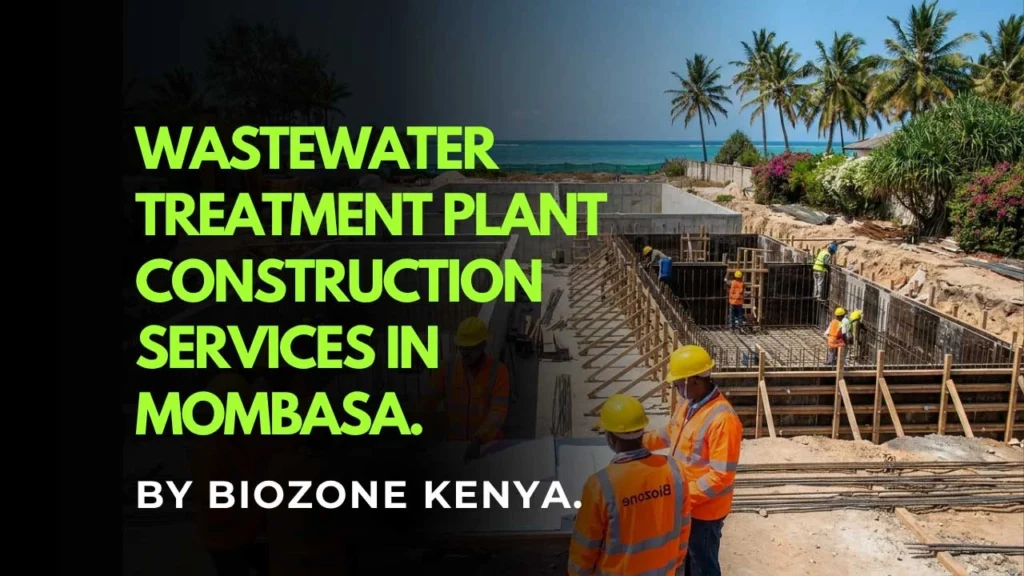
The Wastewater Challenge in Mombasa County
Mombasa County is home to approximately 1.2 million residents spread across six constituencies: Mvita, Nyali, Kisauni, Changamwe, Likoni, and Jomvu. While the Mombasa Water and Sewerage Company (MOWASCO) operates a municipal sewer network in parts of the city, significant coverage gaps exist in Kisauni, Nyali, Bamburi, Likoni, and peri-urban areas on the island’s periphery. Properties in these zones rely on septic tanks and pit latrines that routinely overflow or require costly exhauster truck services, creating recurring operational expense and public health risk.
Mombasa’s coastal geology adds a layer of complexity not found in inland counties. Coral rag and sandy soils provide poor effluent filtration, and high water tables across much of the island mean conventional below-ground septic systems risk contaminating shallow groundwater. Above-ground wastewater treatment plant installation becomes not just a preference but an engineering necessity in many locations.
Perhaps most critically, Mombasa’s waterways and marine environment demand exceptional discharge standards. Tudor Creek, Port Reitz Creek, and the surrounding Indian Ocean coastline support mangrove ecosystems and the protected Mombasa Marine National Park and Reserve. Untreated or poorly treated effluent entering these water bodies carries severe ecological consequences and attracts enforcement action from the National Environment Management Authority (NEMA). For full-cycle construction and compliance support, see Biozone’s dedicated page on wastewater treatment plant construction in Kenya.
Who Needs a Wastewater Treatment Plant in Mombasa?
Residential Developers and Apartment Owners
Rapid apartment development along the Nyali ridge, Bamburi beach corridor, and Likoni hillside has outpaced MOWASCO infrastructure. Developers and property managers across these areas face mounting exhauster truck costs and the risk of neighbour complaints or NEMA notices. A purpose-built on-site system eliminates both problems while adding a verifiable selling point for eco-conscious tenants.
Coastal Hotels, Resorts, and Tourism Facilities
Mombasa’s tourism sector, centred on Nyali, Bamburi, and the broader North Coast strip, generates high volumes of mixed organic wastewater from kitchens, laundry, and sanitation. Beach hotels operating within proximity to the marine park must meet strict discharge standards or recirculate treated water internally. Biozone’s sewage water recycling systems are engineered to handle the variable loading patterns of hospitality facilities.
Industrial and Port Facilities
The Changamwe Industrial Area, Miritini Industrial Zone, Mombasa Special Economic Zone, and Port Reitz environs host manufacturing, fish processing, oil refining support, and logistics operations, all generating process and sanitary wastewater requiring treatment before discharge to receiving water bodies or the municipal system.
Institutions: Hospitals, Schools, and Public Facilities
Large institutions such as Coast General Teaching and Referral Hospital, Aga Khan Hospital Mombasa, Technical University of Mombasa, Mombasa Teachers Training College, and Kenya Medical Training College Mombasa generate consistent wastewater volumes that demand reliable, year-round treatment systems with documented compliance records.
Wastewater Treatment Plant Construction Services in Mombasa: By Client Type
Wastewater Treatment Plant Construction for Beach Hotels and Coastal Resorts in Mombasa
Hotels and beach resorts along the Mombasa coastline operate under the dual pressure of maintaining premium guest environments and complying with strict NEMA discharge limits near the Mombasa Marine National Park. Biozone designs Sequencing Batch Reactor (SBR) and Anaerobic Sequencing Batch Reactor (ASBR) systems sized for the cyclical loading patterns of hospitality facilities, where occupancy varies by season. Treated effluent meeting BOD 11 mg/L can be reused for landscape irrigation, reducing freshwater demand in a county where water scarcity is an ongoing concern. Odourless operation protects the guest experience at all times.
Wastewater Treatment Plant Construction for Residential Apartments and Estates in Mombasa
Residential developers in Nyali, Bamburi, and Kisauni increasingly face NEMA conditions attached to Environmental Impact Assessment approvals that require on-site wastewater treatment. Biozone’s SBR systems serve populations from a single household through to large multi-block apartment complexes, producing treated water suitable for toilet flushing and garden irrigation. This eliminates exhauster truck dependence entirely, a benefit that has been independently verified at an apartment complex that stopped all exhauster services more than two years after Biozone’s installation. Above-ground tank configurations address the high water table conditions common in coastal Mombasa.
Wastewater Treatment Plant Construction for Port and Shipping Facilities in Mombasa
The Port of Mombasa, handling over 30 million tonnes annually, along with associated logistics yards, container depots, ship repair yards, and fuel handling facilities in Port Reitz, generates both sanitary wastewater and process effluent. Facilities operating within the port precinct require robust systems that can handle variable flow, withstand the operational demands of a 24-hour working environment, and produce effluent meeting WRA and NEMA discharge standards before it can reach Port Reitz Creek or the harbour. Biozone’s engineering team provides full hydraulic design, civil construction, and compliance documentation for port-sector clients.
Wastewater Treatment Plant Construction for Fish Processing Plants and Fish Markets in Mombasa
Fish processing is a major sector along the Mombasa coastline, generating high-strength organic effluent rich in fats, proteins, and suspended solids. Untreated fish processing wastewater discharged near Tudor Creek or Port Reitz Creek creates severe odour, depletes dissolved oxygen in receiving waters, and attracts NEMA enforcement. Biozone engineers systems capable of handling the high organic load from fish gutting, washing, and processing operations. Fixed Film and Moving Bed Biofilm Reactor (MBBR) technologies are particularly suited to these high-strength streams.
Wastewater Treatment Plant Construction for Hospitals and Health Centres in Mombasa
Hospitals including Coast General Teaching and Referral Hospital and Aga Khan Hospital Mombasa generate wastewater containing pathogens, pharmaceutical residues, and elevated biological oxygen demand. Effective treatment is both a public health imperative and a licensing requirement. Biozone’s systems incorporate tertiary treatment including UV disinfection, reducing pathogen loads to safe discharge or reuse standards. Biozone supplies and installs UV units and dosing pumps as part of a complete treatment train, and provides the maintenance programmes required to sustain compliance records for regulatory inspections.
Wastewater Treatment Plant Construction for Schools and Colleges in Mombasa
Technical University of Mombasa, Kenya Medical Training College Mombasa, Mombasa Teachers Training College, and numerous secondary schools across the county operate large student populations that produce consistent sanitary wastewater volumes. Many school campuses sit in areas without MOWASCO sewer access. Biozone designs compact systems with low electricity consumption, quiet operation, and standard alarm systems suitable for educational environments. The low operational cost profile means school budgets are not burdened by ongoing chemical or mechanical complexity.
Wastewater Treatment Plant Construction for Restaurants and Food Courts in Mombasa
Restaurants, food courts, and commercial kitchens in Mombasa’s CBD, Nyali Centre, and along the tourist corridors generate grease-laden wastewater that overwhelms municipal drains and attracts health compliance notices. Biozone designs systems incorporating grease interceptors, aerated treatment stages, and effluent polishing appropriate to commercial food service volumes. The result is a system that meets county sanitation requirements while reducing the risk of blockages, odour, and operational shutdowns.
Wastewater Treatment Plant Construction for Industrial Manufacturing Facilities in Mombasa
The Changamwe Industrial Area and Miritini Industrial Zone house manufacturing operations generating complex mixed wastewater streams combining sanitary flows and process effluent. Industries operating in the Mombasa Special Economic Zone face regulatory scrutiny from both NEMA and WRA, particularly given proximity to Port Reitz Creek. Biozone provides full wastewater characterisation, technology selection, detailed engineering design, civil construction, and post-commissioning support for industrial clients. Activated Sludge, MBBR, and Membrane Bioreactor (MBR) technologies are available depending on effluent characteristics and space constraints.
Wastewater Treatment Plant Construction for Government and Public Facilities in Mombasa
County government offices, public markets, police stations, correctional facilities, and housing estates developed under the National Housing Corporation (NHC) across Mombasa require reliable, low-maintenance wastewater systems that can operate with minimal specialist attention. Biozone’s systems include standard alarm monitoring and require no chemical dosing in the core biological treatment stage, reducing the skills burden on facility caretakers. Full documentation is provided for public procurement and audit requirements.
Wastewater Treatment Plant Construction for NGO and Mission Facilities in Mombasa
International NGOs, faith-based organisations, and mission hospitals operating in Mombasa and coastal Kenya face the same NEMA compliance obligations as commercial operators, but often with tighter capital budgets. Biozone works with NGO procurement processes, provides itemised bill-of-quantities documentation compatible with donor reporting requirements, and offers phased construction options that align with grant funding cycles. Mobile and portable biodigester versions are available for temporary or field installations.
Biozone’s Full Lifecycle Wastewater Services in Mombasa
Unlike equipment suppliers who deliver a packaged plant and leave, Biozone provides end-to-end project ownership, from initial site survey and hydraulic design, through civil construction and biological commissioning, to long-term maintenance and regulatory support. Biozone’s ASBR and SBR systems are engineered in-house, not rebranded imports, and the company applies its own biological enzymes and microbial cultures to maintain treatment performance after handover.
Phase 1: Site Survey and Assessment
Every Mombasa project begins with a site visit to evaluate available land, soil conditions (coral rag or sandy coastal soils), water table depth, inlet flow characteristics, and proximity to sensitive water bodies. This survey informs technology selection and determines whether above-ground or below-ground tank placement is appropriate.
Phase 2: Design and Engineering
Biozone produces full hydraulic and process designs, civil and structural drawings, and equipment specifications. Designs comply with Ministry of Water and Irrigation guidelines (December 2008), NEMA EIA standards, and WRA discharge licence requirements. Biozone prepares technical reports suitable for submission to county, NEMA, and WRA offices.
Phase 3: Civil Construction and Tank Installation
Biozone’s construction team handles all civil works including excavation (where applicable), tank placement, pipework, electrical connections for 2 or 3-phase power, blower installation, and site restoration. The company holds a 5-year tank warranty on all installed systems.
Phase 4: Biological Commissioning
At commissioning, Biozone seeds the system with specialist microbial cultures and Envirozyme BFB biological treatment products, accelerating the development of an active biological treatment community and ensuring the system reaches compliant effluent quality within the shortest possible timeframe.
Phase 5: Handover, Training, and Documentation
On completion, Biozone provides operations manuals, maintenance schedules, alarm response guides, and staff training. All compliance documentation is handed over in formats accepted by NEMA and WRA inspectors.
Phase 6: Ongoing Maintenance and Rehabilitation
Biozone offers scheduled biodigester maintenance and rehabilitation programmes and supplies replacement wastewater treatment appliances and equipment including blowers, filters, UV units, dosing pumps, and chemical tanks. For existing systems that have underperformed, Biozone’s rehabilitation service restores treatment efficiency without full replacement.
How Wastewater Treatment Works: From Inlet to Reuse
Understanding the treatment process helps property owners and facility managers evaluate technology options and verify that a proposed system will meet their discharge or reuse requirements. Here is a plain-language overview of the five main treatment stages as implemented in Biozone’s systems.
Stage 1: Preliminary Treatment
Raw sewage entering the treatment plant passes through screening and grit removal stages that capture rags, solids, and coarse inorganic material. This protects downstream mechanical components, particularly blowers and pumps, from damage and blockage. In Mombasa’s coastal setting, preliminary treatment also captures sand and grit that may enter the system from coral rag soils during heavy rainfall events.
Stage 2: Primary Treatment
Screened sewage flows into a primary settlement chamber where heavy solids settle as primary sludge and floatable materials are skimmed. This stage reduces the organic load on the biological treatment stage, improving overall system efficiency and reducing energy consumption. Primary sludge is periodically removed for further processing or licensed disposal.
Stage 3: Secondary Biological Treatment
Secondary treatment is where the most significant contaminant reduction occurs. Biozone’s SBR and ASBR systems create controlled conditions for aerobic and anoxic microbial communities to break down dissolved organic matter and remove nitrogen through linked nitrification and denitrification cycles. Nitrification converts ammoniacal nitrogen to nitrate using aerobic bacteria. Denitrification then converts nitrate to harmless nitrogen gas under anoxic conditions. This complete carbon and nitrogen removal cycle is why Biozone systems achieve a verified BOD of 11 mg/L and ammoniacal nitrogen of 7 mg/L in treated effluent, outputs that consistently satisfy Kenya’s discharge standards and align with WHO guidelines on wastewater reuse.
Stage 4: Tertiary Treatment
Tertiary treatment polishes the secondary effluent to remove residual suspended solids, pathogens, and trace contaminants. Technologies at this stage include filtration, UV disinfection, and chemical dosing where required. For hospital and food industry clients in Mombasa, tertiary treatment is essential to meet pathogen reduction targets. Biozone supplies and integrates all tertiary equipment as part of its turnkey construction service. For sewage water recycling systems designed for reuse applications, tertiary treatment ensures the treated water is safe for its intended purpose.
Stage 5: Effluent Reuse or Licensed Discharge
Fully treated effluent from a Biozone system can be directed to landscape irrigation, toilet flushing, or process water reuse, reducing freshwater consumption and water bills. Where reuse is not practical, the treated effluent meets the standards required for discharge under a WRA water discharge licence, including to sensitive receiving water bodies near Tudor Creek and the Indian Ocean. Biozone assists clients in preparing and submitting discharge licence applications as part of its lifecycle service.
Planning and Design Considerations for Mombasa’s Coastal Environment
Mombasa presents a distinct set of engineering and regulatory design parameters that differ substantially from inland county projects. Any wastewater treatment plant construction in Mombasa must account for these local conditions from the outset of the design process.
Coral rag and sandy coastal soils dominate much of the island’s subsurface, particularly in Nyali, Bamburi, and older parts of Mvita. These formations limit conventional infiltration-based disposal and complicate excavation for below-ground tanks. Biozone’s site assessment process includes soil profiling to determine the optimal foundation and tank placement approach.
High water tables across the coastal island mean that below-ground installation risks flotation of empty tanks and contamination of shallow groundwater during construction and operation. Above-ground wastewater treatment plant installation resolves this challenge cleanly, and Biozone has designed and constructed numerous above-ground systems for Mombasa clients without compromising treatment performance or aesthetics.
Proximity to marine protected areas imposes additional discharge standard requirements. Sites within or adjacent to the Mombasa Marine National Park and Reserve, or within defined setback distances from Tudor Creek, Port Reitz Creek, and the Indian Ocean shoreline, face stricter NEMA monitoring and may require additional tertiary treatment stages.
Tidal influence on drainage gradients near the island’s edges affects hydraulic calculations for gravity-outlet systems. Biozone’s designs incorporate pumped outlets where tidal fluctuation would compromise gravity drainage, ensuring consistent system performance regardless of tidal state.
What Does Wastewater Treatment Plant Construction Cost in Mombasa?
Biozone does not publish fixed price lists because every site and project specification is different. The following explains the factors that determine cost, the difference between capital and operational expenditure, and why two apparently similar projects can carry significantly different price tags.
What Determines the Cost of a WWTP in Mombasa?
The primary cost drivers for any wastewater treatment plant project in Mombasa include the daily flow volume (measured in cubic metres per day), the strength and composition of the incoming wastewater, the treatment technology selected, site conditions including water table depth and soil type, the distance of the site from the nearest access road for heavy equipment, the degree of civil works required, and whether above-ground or below-ground installation is appropriate.
Projects serving large industrial sites in Changamwe or Miritini with high-strength process wastewater require larger, more complex systems than a residential apartment block in Kisauni generating domestic sewage only. The presence of coral rag requiring mechanical breaking during excavation can also influence civil works costs. Biozone provides detailed, itemised quotations after completing a site survey, ensuring clients understand what they are paying for at every line item.
CAPEX vs OPEX: The Total Cost of Ownership Perspective
Capital expenditure (CAPEX) covers design, civil construction, tank supply and installation, pipework, electrical works, blowers, and commissioning. Operational expenditure (OPEX) covers electricity consumption, biological treatment products, scheduled maintenance, sludge removal, and eventual component replacement. Biozone’s systems are designed for low OPEX, using low-power blowers, long-life filter media, and Envirozyme BFB biological treatment products that reduce chemical dependency.
For clients currently spending on exhauster trucks, the OPEX comparison is particularly favourable. Eliminating exhauster dependency typically delivers a measurable payback on the CAPEX investment within a defined operating period, and Biozone can help clients model this comparison as part of the site assessment process.
Why Quotes Vary Between Providers
Quotes from different providers may vary because of differences in technology, design adequacy, materials quality, civil works depth, warranty terms, and post-installation support included. A lower upfront price that does not include commissioning, biological seeding, staff training, or a maintenance programme may result in a system that underperforms within its first operating year. Biozone’s quotations cover the full project scope and include a 5-year tank warranty and access to Biozone’s engineering team throughout the system’s life.
Contact us for a site assessment and a detailed project quotation tailored to your Mombasa site.
Wastewater Treatment Technology Comparison for Mombasa Projects
Selecting the right technology for a Mombasa wastewater project depends on site constraints, effluent characteristics, reuse intentions, and regulatory requirements. The table below compares the six main technologies in Biozone’s design repertoire against the factors most relevant to coastal Kenya conditions.
| Technology | Best Suited For | Footprint | Effluent Quality | Power Requirement | High Water Table Suitability |
|---|---|---|---|---|---|
| ASBR (BZM Fix Model) | Large communities, industrial, institutional | Moderate to large | Full C&N removal, BOD 11 mg/L verified | 2 or 3-phase, low consumption | Above-ground installation available |
| SBR (BZM Model) | Residential to large-scale, hotels, schools | From 2 sq m | Full C&N removal, irrigation/reuse quality | Low | Above-ground installation available |
| Biodigester (Three-Stage) | Domestic and commercial, remote sites | Compact, from 4,000L | EIA compliant, reduced BOD | Passive (no blowers for basic model) | Mobile/portable versions available |
| MBR (Membrane Bioreactor) | Space-constrained sites, high-quality reuse | Very compact | Very high, near potable quality | Moderate to high | Above-ground installation available |
| MBBR (Moving Bed Biofilm Reactor) | Industrial effluent, fish processing, food industry | Compact | High, suitable for discharge | Low to moderate | Above-ground installation available |
| Activated Sludge | Large municipal-scale or industrial flows | Large | High, full biological treatment | Moderate | Civil design required |
Biozone takes a technology-agnostic approach to project design: rather than promoting one system for all clients, Biozone’s engineers assess each project on its individual merits and recommend the technology that delivers the best outcome at the lowest total cost of ownership. Where a client’s effluent characteristics call for an MBBR approach as described in the EPA technical overview of MBBR systems, that is what Biozone will design. Where a compact SBR serves the need more efficiently, that technology will be specified instead.
Biological treatment performance is supported by Biozone’s own specialist wastewater enzymes and microbes, which accelerate system startup and maintain treatment consistency through the variable loading conditions common in Mombasa’s hospitality and seasonal commercial sectors. For clients considering a biodigester option, Biozone also offers biodigester septic tanks as an entry-level or supplementary solution for smaller flows.
Sludge Management in Mombasa’s Coastal Context
All biological wastewater treatment systems generate sludge as a by-product of the treatment process. Effective sludge management is an integral part of system design and operation, and in Mombasa’s coastal environment it requires particular attention.
Inland counties often have agricultural land available for biosolids application as soil conditioner, a practice regulated by NEMA and the Ministry of Agriculture. In Mombasa’s predominantly urban coastal setting, agricultural land application is limited. Sludge generated from Biozone systems must therefore be collected by licensed sludge removal contractors and transported to licensed disposal or processing facilities. Biozone designs systems with sludge return facilities that minimise sludge production volumes, reducing the frequency and cost of removal.
Biozone’s project handover documentation includes a sludge management plan specifying draw-down frequency, volume estimates, and recommended licensed contractors operating in Mombasa County. This documentation supports clients in maintaining compliance with NEMA sludge disposal requirements and avoids the risk of unmanaged sludge accumulation that degrades treatment performance over time.
Common Wastewater Treatment Challenges in Mombasa and How Biozone Solves Them
The following problem-solution pairs reflect the most frequently encountered issues at Mombasa wastewater sites based on Biozone’s experience across 4,000+ projects nationwide, including coastal installations.
Problem: Exhauster Trucks Are a Monthly or Weekly Cost That Never Ends
Solution: Biozone’s SBR and ASBR systems process all wastewater on-site to a standard suitable for reuse or discharge, eliminating exhauster dependence entirely. An apartment complex served by Biozone has independently confirmed zero exhauster truck use for more than two years post-installation.
Problem: NEMA Has Issued a Notice or Condition Requiring Compliance
Solution: Biozone provides the full compliance pathway, from NEMA EIA technical input through system design, construction, effluent testing, and discharge licence application, covering all documentation required to satisfy regulatory conditions.
Problem: The Site Has a High Water Table and Below-Ground Installation Is Not Feasible
Solution: Biozone designs and constructs above-ground wastewater treatment plant configurations using structurally engineered tank supports and screened enclosures. This is a standard Biozone offering for coastal Mombasa sites.
Problem: The Existing Septic Tank or Biodigester No Longer Performs Adequately
Solution: Biozone offers septic-to-biodigester and septic-to-WWTP conversion services, as well as biodigester rehabilitation for systems that have degraded. Many existing structures can be repurposed as part of a new treatment train, reducing civil construction costs.
Problem: The System Produces Odours That Affect Neighbours or Guests
Solution: Biozone’s enclosed, aerated systems operate without odour under normal conditions. Where odour is arising from an existing system, Biozone’s engineers identify the cause, which is commonly inadequate aeration or overloading, and apply a corrective solution including blower upgrades and biological re-seeding with Envirozyme BFB.
Problem: The Hotel or Resort Needs Treated Water for Irrigation but Unsure of Reuse Safety
Solution: Biozone’s tertiary treatment options produce effluent tested to verified BOD and ammoniacal nitrogen standards that meet WHO reuse guidance and Kenya’s irrigation reuse criteria. Biozone provides effluent quality reports for client records and regulatory submissions. View examples on the project portfolio.
Regulatory Compliance for Wastewater Treatment in Mombasa
Wastewater treatment in Mombasa County is governed by a layered regulatory framework at national, county, and environmental authority levels. Non-compliance carries the risk of stop orders, fines, and public health liability. Biozone manages the full compliance process on behalf of its clients.
At the national level, the National Environment Management Authority (NEMA) is the principal regulator for Environmental Impact Assessments, effluent discharge standards, and enforcement. All new wastewater treatment installations above a defined threshold require an EIA licence. Biozone prepares EIA technical chapters and coordinates with licensed EIA experts on behalf of clients.
The Water Resources Authority (WRA) governs water abstraction and discharge licensing under the Water Act 2016. Clients discharging treated effluent to surface water bodies, including Tudor Creek, Port Reitz Creek, or the Indian Ocean, require a WRA discharge licence specifying the permitted flow volumes and effluent quality parameters. Biozone prepares the technical documentation required for licence applications and provides the effluent quality data needed to demonstrate compliance at licence renewal.
Mombasa County Government enforces local building and sanitation by-laws applicable to wastewater system construction. Additional coastal-specific requirements apply near the Mombasa Marine National Park and Reserve, including discharge setback distances and enhanced effluent quality standards. Coastal development permit requirements enforced by the Kenya Coast Guard and relevant national agencies also apply to infrastructure within defined coastal zone boundaries. Biozone’s design team incorporates all applicable setback and quality requirements into project specifications before construction begins.
Emerging Trends in Wastewater Treatment Relevant to Mombasa
The wastewater sector in Mombasa is being shaped by converging forces: tightening NEMA enforcement, growing freshwater scarcity, expanding hotel and residential development, and the global sustainability agenda crystallised in UN SDG 6: Clean Water and Sanitation. Several trends are directly influencing project briefs in the county.
Water reuse is gaining traction among hotel developers and large residential estates in Nyali and Bamburi who face rising water tariffs from MOWASCO. Treated effluent reused for irrigation and toilet flushing can reduce freshwater demand by 30 to 50 percent in a typical residential complex. Biozone’s SBR systems are designed with reuse as the default output, not an afterthought.
Biological treatment products are replacing chemical-heavy treatment approaches across the sector. Biozone’s biological water recycling solution using Envirozyme BFB and specialist microbial cultures offers effective treatment with lower chemical inputs, reduced sludge production, and a more stable biological process, advantages that align with the environmental sensitivity of Mombasa’s coastal setting.
Decentralised treatment is emerging as the pragmatic answer to MOWASCO coverage gaps. Rather than waiting for municipal sewer extension, property developers and institutions across Kisauni, Likoni, and peri-urban Jomvu are investing in on-site systems that deliver immediate compliance and long-term operational independence.
Areas We Serve in Mombasa County
Biozone serves all six constituencies of Mombasa County including Mvita, Nyali, Kisauni, Changamwe, Likoni, and Jomvu, providing wastewater treatment plant construction, consultancy, and maintenance throughout the county.
In the Mvita constituency, which encompasses Mombasa’s central business district, Old Town, and the port precinct, Biozone serves commercial buildings, hotels, government offices, and port-adjacent industrial facilities in Shimanzi, the CBD, and surrounding areas. Space constraints in the dense urban core make compact above-ground SBR and MBR systems particularly relevant.
In Nyali, Mombasa’s premium residential and hospitality zone, Biozone has worked with apartment developers, gated estate managers, and beach hotel operators along the Nyali ridge and beachfront. The high water table in lower-lying parts of Nyali has driven demand for above-ground system configurations.
The Kisauni and Bamburi corridor, including the Bamburi beach hotel strip and inland residential areas extending toward Mtwapa, is one of Mombasa’s fastest-growing development zones. Biozone serves hotels, residential projects, schools, and healthcare facilities across this corridor.
In Likoni, south of the Kilindini Harbour crossing, growing residential developments and commercial activity on the south coast are generating demand for on-site treatment solutions where MOWASCO infrastructure has not yet reached. Biozone serves Likoni clients with systems designed for the area’s sandy soils and variable topography.
Across Changamwe and the adjacent Miritini zone, including the Changamwe Industrial Area, Mombasa SEZ, and Port Reitz, Biozone provides industrial and commercial wastewater systems. In Jomvu and Mikindani, including peri-urban and light industrial areas at the county’s northern boundary, Biozone offers the same full range of services.
Why Choose Biozone for Wastewater Treatment Plant Construction in Mombasa?
Biozone was founded in 2015 by Henry Chochu, an aeronautical engineering graduate whose precision engineering background is reflected in the technical rigour applied to every project. With over 10 years of wastewater management experience and more than 4,000 clients served across Kenya, Biozone brings a depth of verified field experience that few providers in the sector can match.
Biozone holds a 5.0-star rating across 215 Google reviews, a reflection of consistent delivery rather than marketing. One verified reviewer confirmed that a water treatment plant installed by Biozone was functioning correctly five years after installation with no major intervention. Another verified review confirmed that an apartment complex had completely eliminated exhauster truck dependency more than two years after Biozone’s system was commissioned.
All Biozone systems are designed and engineered in-house. The ASBR (BZM Fix Model) and SBR (BZM Model) are Biozone’s own technology platforms, not rebranded imports. This means the engineering team that designed your system is also the team that supports it, removing the knowledge gap that commonly affects third-party resellers.
Biozone is a partner of Prions Biotech, extending its capability in biological treatment products and specialist microbial solutions. The company’s systems comply with Kenya EIA standards and Ministry of Water and Irrigation guidelines, and Biozone actively supports clients through NEMA and WRA regulatory processes, not just the construction phase.
For Mombasa clients specifically, Biozone’s experience with above-ground installation for high water table sites, coastal soil conditions, and marine protected area discharge requirements makes it one of very few providers in Kenya with demonstrable coastal-specific engineering competence.
Frequently Asked Questions: Wastewater Treatment Plant Construction in Mombasa
Can wastewater treatment plants be installed in high water table coastal areas in Mombasa?
Yes. Biozone routinely designs and constructs above-ground wastewater treatment systems for coastal Mombasa sites where high water tables make below-ground installation impractical or unsafe. Above-ground configurations use structurally engineered tank supports and screened enclosures, delivering full treatment performance without the flotation risk or groundwater contamination concerns associated with below-ground placement in saturated coastal soils.
What NEMA regulations apply to wastewater discharge near the Indian Ocean and Tudor Creek in Mombasa?
NEMA’s Water Quality Regulations under the Environmental Management and Coordination Act (EMCA) govern effluent quality for any discharge to surface water bodies in Kenya, including the Indian Ocean, Tudor Creek, and Port Reitz Creek. Sites near the Mombasa Marine National Park and Reserve face enhanced scrutiny and may be subject to additional effluent quality conditions under the marine park’s management framework. Biozone prepares all required NEMA documentation and ensures that installed systems meet or exceed the required discharge standards before any effluent is released.
Which wastewater treatment technology is best for beach hotels and coastal resorts in Mombasa?
For most beach hotels and coastal resorts, Biozone’s SBR (BZM Model) or ASBR (BZM Fix Model) systems are the most appropriate choice. Both deliver full carbon and nitrogen removal, producing odourless, clear effluent suitable for landscape irrigation. The SBR’s ability to handle variable daily loading, which is common in hospitality facilities where occupancy fluctuates, makes it particularly well-suited. Where space is extremely constrained, an MBR system may be specified for its smaller footprint.
How long does wastewater treatment plant construction take in Mombasa?
Project timelines depend on system size, site conditions, and the complexity of civil works required. A standard residential or small commercial installation typically takes four to eight weeks from mobilisation to commissioning. Larger industrial or institutional projects may require three to six months. Biozone provides a detailed programme at the project design stage so clients can plan for construction access and temporary service arrangements.
Does Biozone handle the NEMA EIA process for Mombasa projects?
Biozone prepares the technical wastewater chapters and engineering documentation required for NEMA EIA submissions, and coordinates with the client’s licensed EIA expert to ensure wastewater treatment design meets EIA approval conditions. Biozone can also prepare the WRA water discharge licence application and supporting technical data on behalf of clients.
What is the difference between a biodigester and a wastewater treatment plant?
A biodigester septic tank is a biologically enhanced containment and partial treatment system suited to domestic and small commercial applications. A full wastewater treatment plant (WWTP) incorporates multiple active treatment stages, aeration, biological nutrient removal, and often tertiary treatment, producing effluent of a significantly higher quality suitable for reuse or discharge. Biozone offers both options and will recommend the most appropriate system based on your flow volume, effluent quality target, and site conditions.
Can Biozone convert an existing septic tank to a proper wastewater treatment system?
Yes. Biozone offers septic-to-biodigester and septic-to-WWTP conversion services that can incorporate existing civil structures where structurally sound, reducing the capital cost of upgrading to a fully compliant system. This service is frequently used by older residential estates and commercial properties in Mvita and Kisauni where original septic infrastructure no longer meets current standards.
How often does a biodigester or WWTP need to be maintained in Mombasa?
Biozone recommends a scheduled maintenance visit every three to six months depending on system type and loading. Maintenance includes biological health checks, blower and pump servicing, filter inspection, UV lamp replacement where applicable, and sludge level assessment. Biozone’s biodigester maintenance and rehabilitation service is available across Mombasa County. Regular maintenance is also a condition of most NEMA discharge licences.
Is treated effluent from a Biozone system safe to use for hotel garden irrigation in Mombasa?
Yes, subject to the system being correctly commissioned and maintained. Biozone’s SBR and ASBR systems produce treated effluent with a verified BOD of 11 mg/L and ammoniacal nitrogen of 7 mg/L, meeting the quality criteria for restricted irrigation reuse as defined in WHO guidelines. Tertiary treatment including UV disinfection is recommended for any reuse application involving human contact. Biozone provides effluent quality test reports as part of its commissioning and maintenance service.
Does Biozone serve areas outside Mombasa Island, such as Mtwapa, Miritini, and Jomvu?
Yes. Biozone serves all six constituencies of Mombasa County and the broader Coast Region, including Mtwapa, Miritini, Jomvu, Mikindani, and surrounding peri-urban areas. The company’s engineering and construction teams are mobilised from Nairobi and from regional contacts, and project management is handled centrally to ensure consistent quality across all locations.
What warranty does Biozone offer on wastewater treatment systems in Mombasa?
Biozone provides a five-year tank warranty on all installed systems. This covers structural integrity of the treatment tanks. Mechanical components including blowers, pumps, UV units, and control panels carry manufacturer warranties, and Biozone coordinates warranty claims and replacements on behalf of clients as part of its maintenance programme.
Can Biozone supply individual equipment components such as blowers, UV units, or dosing pumps in Mombasa?
Yes. In addition to full wastewater treatment plant construction, Biozone supplies individual components including blowers, filters, UV units, dosing pumps, chemical tanks, and Envirozyme BFB biological treatment products. This service is useful for clients who have existing systems requiring specific component upgrades or replacements without full system replacement.
Ready to Solve Your Wastewater Challenge in Mombasa? Talk to Biozone Today.
Whether you are developing a residential estate in Nyali, managing a beach hotel in Bamburi, operating a processing plant in Changamwe, or running a hospital or school anywhere across Mombasa County: Biozone has the engineering experience, the proven technology, and the compliance knowledge to deliver a system that works from commissioning day through to year ten and beyond.
With 4,000+ projects delivered, 215 five-star Google reviews, verified effluent quality at BOD 11 mg/L, and a 10-year track record in Kenya’s most demanding environments, Biozone is the partner coastal developers and facility managers trust for wastewater treatment that complies, performs, and lasts.
Contact us for a site assessment and take the first step toward clean, compliant wastewater management in Mombasa.
- Phone and WhatsApp: +254 111 715 578
- Email: info@biozone.co.ke
- Office Hours: Monday to Friday 8:30 to 17:00 | Saturday 9:00 to 12:00
- Website: https://www.biozone.co.ke/contact/