

Lake Victoria Compliance, Zero Exhauster Trucks, and Verified Effluent Quality
★★★★★ 5.0 Rating: 215 Google Reviews | 4,000+ Projects Delivered | 10+ Years in Kenya | Verified BOD Output: 11 mg/L
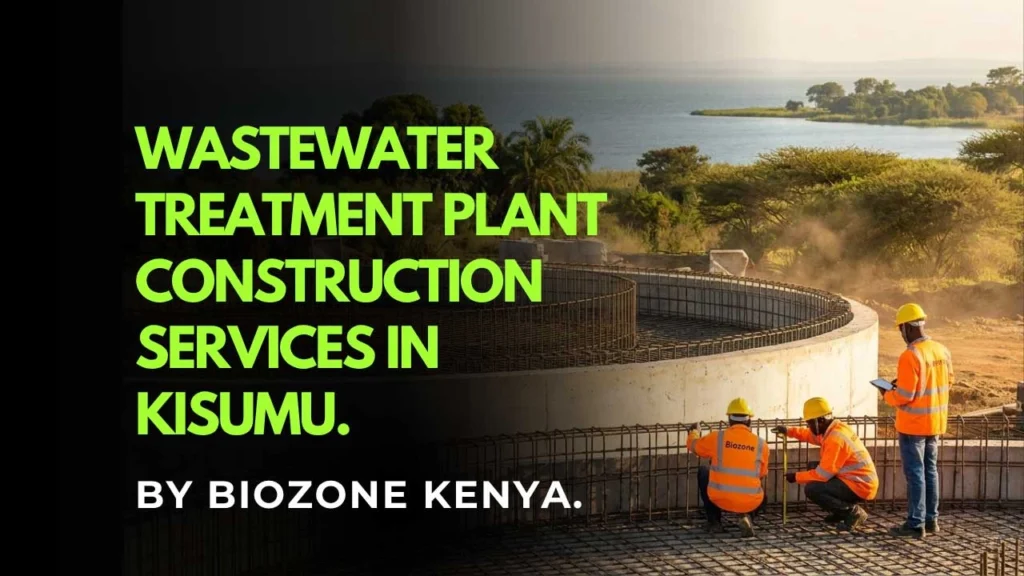
Kisumu sits on the edge of Lake Victoria, Kenya’s most ecologically sensitive receiving water body, and every litre of untreated effluent released into the lake, the Winam Gulf, or the Nyando wetlands carries consequences that extend far beyond a compliance notice. That is why at Biozone, we offer professional services in Wastewater Treatment Plant Construction in Kisumu
Biozone (Blueflame Energy Solutions Ltd) has been engineering wastewater treatment consultancy and on-the-ground construction solutions in Kenya since 2015, serving more than 4,000 clients across the country with systems that produce odourless, reuse-quality effluent verified at a BOD of 11 mg/L and ammoniacal nitrogen of 7 mg/L. Whether you operate a fish processing facility in Kondele, a lakeshore hotel along Winam Gulf, or a residential estate in Nyalenda, Biozone engineers a system that meets the strict NEMA and Water Resources Authority standards applicable to Lake Victoria catchment discharges.
- Full compliance with NEMA and WRA effluent standards for Lake Victoria catchment discharges.
- Verified treated water suitable for toilet flushing, irrigation, and regulated surface discharge.
- Systems engineered for Kisumu’s clay and black cotton soils, flat lacustrine terrain, and high water table conditions near the lake shore.
- Purpose-designed solutions for fish processing, sugar factories, hospitals, hotels, schools, and apartments.
- Exhauster trucks eliminated: multiple Biozone clients across Kenya have operated exhauster-free for over two years post-installation.
Contact us for a site assessment and receive a technical review of your site, your effluent load, and the most appropriate treatment pathway for your Kisumu project.
Call or WhatsApp: +254 111 715 578

The Kisumu Wastewater Challenge: Why Standard Solutions Fall Short
Kisumu Water and Sanitation Company (KIWASCO) provides sewer coverage across parts of Kisumu City centre, but large coverage gaps remain across peri-urban areas, including Nyalenda, Manyatta, Kondele, and Mamboleo, as well as rural constituencies such as Muhoroni, Nyando, Nyakach, and Seme. Developers, institutions, and industrialists in these areas cannot connect to a central sewer and must provide on-site treatment.
The ecological context raises the stakes significantly. Lake Victoria is Kenya’s most critically sensitive receiving water body. Discharges into any tributary, wetland, or direct lake outlet require permits from both the National Environment Management Authority (NEMA) and the Water Resources Authority, with effluent quality standards that are stricter than those applied elsewhere in the country. The Nyando Delta, located within Nyando Constituency, is a Ramsar-listed wetland of international importance and receives effluent from Ahero, Katito, and surrounding areas via the Nyando River. Untreated or poorly treated effluent reaching these systems contributes to algal blooms, fish die-offs, contamination of artisanal fishing grounds, and public health crises affecting the 1.15 million people who live, work, and depend on the lake.
Biozone’s systems are specifically designed to meet these elevated compliance requirements. Explore our full range of wastewater treatment plant construction in Kenya to understand the technical depth behind each installation.
Who Needs a Wastewater Treatment Plant in Kisumu?
Residential Developers and Estate Managers
Apartment blocks and gated estates in Nyalenda, Manyatta, Kajulu, and Kombewa that lie outside KIWASCO’s sewer reach require on-site treatment. Biozone’s SBR (BZM Model) scales from individual households to large multi-unit developments. Treated water is reused for toilet flushing and irrigation, eliminating costly exhauster truck dependencies.
Commercial Establishments: Hotels, Restaurants, and Port Facilities
Lakeshore hotels, lodges near Hippo Point, restaurants in Kisumu CBD, and facilities at Kisumu Port generate high-strength effluent that cannot legally discharge into Winam Gulf without treatment. Our sewage water recycling systems are built to meet the stringent lake-discharge standards required in this zone.
Industrial and Processing Facilities
Fish processing plants in Kondele, sugar factories in the Muhoroni belt, breweries, and manufacturers in the Kisumu Export Processing Zone (EPZ) generate high-load effluent with elevated BOD, suspended solids, and ammonia. Industrial-scale treatment systems including ASBR (BZM Fix Model), MBR, and MBBR configurations are deployed depending on site conditions and effluent characteristics.
Institutional Facilities
Jaramogi Oginga Odinga Teaching and Referral Hospital (JOOTRH), Maseno University, Kisumu National Polytechnic, and Kenya Medical Training College generate continuous high-volume sewage flows. On-site WWTP systems protect staff, students, and surrounding communities from pathogen exposure and regulatory penalties.
Wastewater Treatment Plant Construction Services in Kisumu: By Client Type
Wastewater Treatment Plant Construction for Fish Processing Plants and Fish Markets in Kisumu
Fish processing in Kisumu is one of the most effluent-intensive industries in the region. Fish filleting, smoking, and export operations in the Kondele and Mamboleo industrial corridor produce high-BOD wastewater loaded with fats, proteins, blood, and cleaning chemicals. Discharge into Lake Victoria or its tributaries without treatment is a criminal offence under NEMA regulations. Biozone engineers systems with pre-treatment screening, grease traps, and biological secondary treatment to achieve lake-safe effluent. The treated water can be recycled for plant cleaning, reducing freshwater consumption costs.
Wastewater Treatment Plant Construction for Sugar Processing Factories in the Muhoroni Area
Sugar processing around Muhoroni generates large volumes of process wastewater and cooling water containing dissolved sugars, suspended solids, and high biochemical oxygen demand. The Nyando River, which flows through Muhoroni toward the Ramsar-listed Nyando Delta, is a regulated watercourse under WRA jurisdiction. Biozone designs large-scale treatment systems including aerated buffer tanks and activated sludge processes to bring effluent within the permitted limits before any discharge. Full EIA compliance documentation and WRA licence application support is provided.
Wastewater Treatment Plant Construction for Residential Apartments and Estates in Kisumu
Multi-unit residential developments in Nyalenda, Manyatta, Kajulu, Mamboleo, and outer Kisumu City that cannot connect to KIWASCO mains must treat sewage on-site. Biozone’s SBR systems fit within a footprint from 2 square metres, integrate above-ground where high water tables or clay soils make below-ground installation impractical, and produce treated water that can be piped for toilet flushing or garden irrigation. A 5-year tank warranty protects the developer’s investment.
Wastewater Treatment Plant Construction for Hotels and Lake-View Lodges in Kisumu
Hospitality establishments along the shores of Lake Victoria and Winam Gulf, from budget guesthouses to upmarket lake lodges near Hippo Point, face the strictest discharge conditions of any commercial category in Kenya. Biozone installs compact, low-noise systems that operate without odour, protecting the guest experience while meeting NEMA’s lake discharge standards. Treated water can be used for landscaping and flushing, reducing water bills considerably in a region where municipal water supply can be intermittent.
Wastewater Treatment Plant Construction for Hospitals and Health Centres in Kisumu
Jaramogi Oginga Odinga Teaching and Referral Hospital (JOOTRH), sub-county hospitals, and private clinics in Kisumu generate sewage streams that may contain pathogens, pharmaceuticals, and chemical disinfectants. Standard biodigesters are insufficient for healthcare effluent. Biozone designs systems with UV disinfection, chemical dosing capability, and tertiary polishing to achieve safe effluent standards. Our systems integrate dosing pumps, UV units, and chemical tanks supplied through our full equipment range.
Wastewater Treatment Plant Construction for Schools, Colleges, and Universities in Kisumu
Maseno University, Kisumu National Polytechnic, Kenya Medical Training College, and secondary schools across all seven constituencies in Kisumu County generate predictable daily sewage loads from large student populations. Many are sited in peri-urban or rural areas without sewer access. Biozone’s SBR systems are sized to the peak institutional flow, are quiet in operation, and require minimal daily supervision, making them practical for school and university environments where dedicated wastewater management staff are not always available.
Wastewater Treatment Plant Construction for Industrial Manufacturing in Kisumu Industrial Area and the EPZ
The Kisumu Industrial Area (centred around Kondele and Mamboleo) and the Kisumu Export Processing Zone house manufacturers whose process wastewater contains a broad range of pollutants. NEMA’s industrial effluent standards for the Lake Victoria catchment are strictly enforced. Biozone provides full consultancy, design, construction, and commissioning of industrial-scale treatment plants including MBR, MBBR, and activated sludge systems. Discharge licence application support to NEMA and WRA is included as part of the project scope.
Wastewater Treatment Plant Construction for Restaurants and Food Courts in Kisumu
Restaurants and food courts in Kisumu CBD, along Oginga Odinga Street, and in commercial centres across Kisumu East and Kisumu West generate grease-laden wastewater that can block drainage systems and pollute groundwater. Biozone’s commercial treatment solutions include grease interceptors, compact biological treatment units, and biodigester configurations that fit within limited urban footprints. Treated effluent meets NEMA standards for drain disposal.
Wastewater Treatment Plant Construction for Government and Public Facilities in Kisumu
County government offices, public markets, bus parks, and municipal facilities across Kisumu County’s seven constituencies are required to demonstrate EIA compliance during development approvals and operational audits. Biozone has extensive experience working with public sector clients on WWTP design, EIA documentation, and construction within constrained budget frameworks. Government facilities near the lake shore or wetland areas receive particular attention to compliance requirements under the Water Act and Environmental Management and Co-ordination Act.
Wastewater Treatment Plant Construction for NGO and Mission Facilities in Kisumu
Non-governmental organisations, mission hospitals, children’s homes, and community centres operating in Kisumu’s rural constituencies including Seme, Nyakach, and Nyando often have limited infrastructure budgets. Biozone designs cost-effective, low-maintenance systems including three-stage biodigesters from 4,000 litres capacity, with mobile and portable versions available for temporary installations. All systems are EIA compliant and accompanied by full regulatory documentation support.
Biozone’s Full Lifecycle Wastewater Services in Kisumu
Phase 1: Site Assessment and Environmental Review
Every Kisumu project begins with a thorough site visit covering soil type, topography, water table depth, proximity to Lake Victoria, the Nyando River, and registered wetlands, and the applicable NEMA and WRA setback requirements. Groundwater and surface water assessments are conducted where required.
Phase 2: System Design and EIA Documentation
Biozone prepares detailed engineering designs, hydraulic calculations, and EIA project reports to satisfy NEMA requirements. For sites near the lake, the design accounts for the Lake Victoria Water Resources Management Authority (LVWRMA) jurisdiction and Ramsar Convention obligations.
Phase 3: Construction and Installation
Our in-house construction teams carry out full civil, mechanical, and electrical installation. Systems operate on 2 or 3-phase power with low electricity consumption. Gravity and pumped outlet configurations are available to suit Kisumu’s flat terrain and varying drainage gradients.
Phase 4: Commissioning and Handover
After installation, every system undergoes commissioning with seeding of biological cultures and effluent quality verification. Client operators receive training on daily monitoring, alarm systems, and routine checks. Standard alarms alert operators to any deviation from normal operating parameters.
Phase 5: Equipment Supply
Biozone supplies a complete range of wastewater treatment appliances and equipment including blowers, filters, UV disinfection units, dosing pumps, chemical tanks, and Envirozyme BFB biological treatment products. Spare parts and consumables are available through our Nairobi supply chain with delivery to Kisumu.
Phase 6: Ongoing Maintenance and Rehabilitation
Biozone provides scheduled and reactive biodigester maintenance and rehabilitation services, including desludging, aeration equipment servicing, media replacement, and system performance audits. Clients operating legacy septic tanks can convert to a fully compliant biodigester or WWTP system.
No other provider in Kisumu County matches this end-to-end capability. Where most contractors stop at construction, Biozone remains engaged across the full system lifecycle, ensuring your investment continues to perform to its designed specification and your compliance record remains clean.
How Wastewater Treatment Works: From Raw Sewage to Reusable Water
Understanding the treatment process helps clients in Kisumu make informed decisions about the right technology for their site and their effluent type. The following stages describe the process used in Biozone’s biological treatment systems. A detailed video walkthrough of the process is available on Biozone’s website for developers who would like a visual explanation before their site assessment.
Preliminary Treatment: Screening and Equalisation
Raw sewage first passes through screens and bar racks that remove large solids such as rags, plastics, and food waste. An equalisation tank buffers flow variations, particularly important for facilities in Kisumu with fluctuating occupancy such as schools, hotels, and fish markets.
Primary Treatment: Sedimentation
Settled primary clarifiers remove suspended solids and allow fats and oils to float to the surface for removal. This stage is particularly important for fish processing effluent and food service applications in Kisumu, where grease and protein loading is high.
Secondary Treatment: Biological Processing
Secondary treatment is the core of the system and achieves the majority of BOD and nitrogen removal. Biozone’s SBR (Sequencing Batch Reactor) and ASBR (Attached Submerged Biofilm Reactor) technologies maintain dense populations of microorganisms that break down dissolved organic matter through aerobic and anoxic cycling. This stage achieves full carbon and nitrogen removal, producing effluent with a verified BOD of 11 mg/L: well below the NEMA standard for Lake Victoria catchment discharges. Our sewage water recycling systems are designed to sustain this performance under varying load conditions, including the seasonal fluctuations typical of Kisumu’s hospitality, fishing, and agricultural sectors. For further technical context on biological treatment performance benchmarks, refer to the WHO guidelines on wastewater reuse.
Tertiary Treatment: Polishing and Disinfection
For sites requiring reuse-quality or regulated surface discharge, tertiary treatment adds sand filtration, UV disinfection, and chemical dosing. This stage is standard for healthcare facilities, institutional clients, and any site discharging within the Lake Victoria catchment where effluent will reach a watercourse.
Sludge Handling and Return
Biozone’s systems incorporate a sludge return facility that recirculates active biological material within the reactor, maintaining treatment efficiency. Excess sludge is periodically removed and disposed of through licensed contractors or, where appropriate, applied to agricultural land as a soil conditioner following stabilisation.
Planning and Design: Addressing Kisumu’s Unique Site Conditions
Kisumu’s physical geography creates a specific set of engineering challenges that must be addressed during the design phase of any wastewater treatment project.
Black cotton and clay soils dominate across much of the county, particularly in the lacustrine plains near the lake shore and along the Nyando River valley. These soils exhibit high shrink-swell behaviour, waterlogging during the long rains, and poor load-bearing capacity. Standard concrete tank designs require reinforcement and anti-flotation measures. Biozone’s design engineers account for soil bearing capacity, seasonal water table fluctuations, and foundation requirements specific to each site.
The flat terrain characteristic of Kisumu’s lake shore and plain areas reduces natural hydraulic gradient, making gravity drainage difficult in some configurations. Biozone designs both gravity and pumped outlet systems, selecting the appropriate configuration based on site topography surveys conducted during the assessment phase.
Proximity to Lake Victoria, the Winam Gulf, the Nyando River, and the Kisian wetlands introduces mandatory regulatory setback requirements. NEMA project reports and WRA water use licence applications must reference these setbacks explicitly. Biozone’s design team is familiar with the specific permit conditions applied within the Lake Victoria Water Resources Management Authority (LVWRMA) area and ensures that no installation proceeds without the appropriate authorisations in place.
Cost of Wastewater Treatment Plant Construction in Kisumu
One of the most common questions we receive from developers and facility managers in Kisumu is: what will a wastewater treatment system cost? The honest answer is that cost varies significantly depending on your site, your effluent load, and the technology required. The following factors drive the project investment.
Factors That Influence System Cost
The primary cost drivers are the daily volume of sewage to be treated (measured in cubic metres per day), the strength of the effluent (BOD loading, ammonia content, fats and oils for fish processing or food service clients), the required outlet standard (reuse or regulated discharge), and site-specific civil works. In Kisumu, additional factors include soil conditions (black cotton soil requires more extensive civil foundations), distance from the lake or protected watercourses (which may require higher-grade tertiary treatment), and access to power supply (2 or 3-phase). Systems with above-ground installation requirements, relevant in high water table areas near the lake shore, also carry different cost structures than below-ground configurations.
Lifecycle Cost vs. Capital Cost
Many clients compare system purchase price without considering lifecycle cost. A poorly specified system installed cheaply may require expensive remediation within two to three years, ongoing exhauster truck costs that can exceed KES 20,000 per visit, regulatory penalties for non-compliant discharge, and eventual decommissioning. Biozone’s systems carry a 5-year tank warranty, low electricity consumption, and a maintenance programme designed to preserve performance over a minimum 20-year operational life. The lifecycle cost comparison almost always favours a correctly specified system from a proven provider.
Request a Site Assessment and Quotation
Biozone does not publish standard price lists because no two sites are identical. The most accurate way to understand the cost of your Kisumu project is to request a site assessment. Our engineers will visit your site, review your effluent load, assess soil and groundwater conditions, confirm the applicable regulatory requirements, and produce a detailed technical and commercial proposal. To arrange your assessment, contact us for a site assessment or call and WhatsApp us directly on +254 111 715 578.
Wastewater Treatment Technology Comparison for Kisumu Projects
Several biological treatment technologies are used in Kenya for on-site wastewater treatment. The right choice depends on your effluent type, site constraints, required effluent quality, and budget. The following table summarises the key technologies Biozone works with, helping you understand the options before your site assessment.
| Technology | Best Suited For | Footprint | Nitrogen Removal | Typical BOD Output | Notes |
|---|---|---|---|---|---|
| SBR (BZM Model) | Residential to large-scale; schools; hospitals | From 2 sq m | Full C&N removal | 11 mg/L verified | Reuse-quality; irrigation and flushing |
| ASBR (BZM Fix Model) | Large communities; industrial; fish processing | Medium to large | Full C&N removal | 11 mg/L verified | Odour-free; continuous flow |
| Biodigester (3-stage) | Domestic; small commercial; remote sites | From 4,000 L tank | Partial | Variable | Mobile versions available; EIA compliant |
| MBR | High-quality reuse; healthcare; tight footprint | Compact | Full | Very low | Highest effluent quality; higher capex |
| MBBR | Industrial; retrofit of existing tanks | Variable | Full | Low | Good for retrofitting legacy systems |
| Activated Sludge | Large municipal and industrial flows | Large | Full | Low | Well-established; energy intensive |
For clients operating near Lake Victoria or its tributaries, MBBR technology has been subject to extensive independent evaluation. The EPA technical overview of MBBR systems provides a useful reference for understanding its performance characteristics in high-load industrial applications.
Biozone takes a technology-agnostic approach to design. Rather than recommending one system across all clients, our engineers assess each site on its own conditions. Clients in Kisumu with legacy septic tanks may be candidates for conversion: our biodigester septic tanks service covers assessments and upgrades for existing installations. For clients who require biological treatment enhancement beyond standard system performance, our specialist wastewater enzymes and microbes product range offers a targeted solution for improving existing system efficiency or recovering underperforming systems.
Sludge Management in Kisumu
Every biological treatment system produces stabilised sludge as a by-product of the treatment process. How that sludge is managed is a critical element of any compliant WWTP operation in Kisumu, particularly given the county’s proximity to ecologically sensitive water bodies.
Biozone’s systems incorporate a sludge return facility that minimises excess sludge production by recycling active biological mass within the treatment process. When sludge does require removal, it is done on a scheduled basis, typically annually or bi-annually for most residential and commercial systems, and disposed of through NEMA-licensed contractors.
For clients in peri-urban areas of Kisumu County, particularly in Nyakach, Seme, and Muhoroni where smallholder and commercial farming is widespread, stabilised sludge from domestic-strength wastewater may be suitable for agricultural land application as a soil conditioner, subject to laboratory testing and County Government approval. Biozone can advise on the regulatory pathway for beneficial sludge reuse and coordinate soil amendment assessments where requested. Sludge from industrial processes, including fish processing or sugar factory effluent, requires specialist disposal arrangements and laboratory characterisation before any land application can be considered.
Common Wastewater Challenges in Kisumu and How Biozone Solves Them
The following problem-solution pairs reflect the most frequently encountered scenarios from clients across Kisumu County. For documented examples, view our project portfolio.
Challenge: Existing septic tank at capacity with exhauster trucks visiting weekly. Solution: Biozone converts the legacy septic tank to a three-stage biodigester or SBR system. The biological process breaks down solids continuously, eliminating the need for regular pump-outs and removing the exhauster truck cost from operations permanently.
Challenge: NEMA project report requires proof of effluent quality for Lake Victoria catchment discharge. Solution: Biozone provides full EIA documentation including design specifications, hydraulic modelling, effluent quality predictions, and post-installation monitoring data from comparable installed systems. Verified BOD of 11 mg/L and ammoniacal nitrogen of 7 mg/L are presented as reference performance data.
Challenge: Clay and black cotton soils make below-ground installation impractical at lakeshore sites. Solution: Biozone’s systems support above-ground installation configurations, with anti-corrosion coatings and insulation appropriate for exposed installation. Foundation design is adapted to the specific soil bearing capacity data collected during the site assessment.
Challenge: Fish processing plant generates high-strength, high-volume effluent with seasonal peaks during landing season. Solution: An ASBR (BZM Fix Model) system is sized for peak load conditions with equalisation capacity to buffer the seasonal variation. Pre-treatment screening and grease removal upstream of the biological reactor protects the process from shock loading.
Challenge: Remote school in Seme or Nyakach Constituency with no mains power connection. Solution: Biozone’s three-stage biodigesters operate without electricity for low-load domestic applications. For systems requiring aeration, a solar power interface can be specified and integrated during design.
Challenge: Existing treatment system underperforming with odour complaints from neighbours. Solution: Biozone’s maintenance and rehabilitation team diagnoses the root cause, which may be biological imbalance, aeration failure, or hydraulic overloading. Remediation may include seeding with specialist microbial cultures, aeration equipment replacement, or system capacity upgrade. Our project portfolio includes verified examples of systems restored to full compliance following rehabilitation works.
Regulatory Compliance for Wastewater Treatment in Kisumu
Operating a compliant wastewater treatment system in Kisumu County involves engagement with several regulatory bodies, each with distinct jurisdictions.
The National Environment Management Authority (NEMA) requires an Environmental Impact Assessment (EIA) project report for any installation above a defined threshold, and issues a licence based on the quality and completeness of that report. For discharges in the Lake Victoria catchment, NEMA applies the most stringent effluent standards in the country, reflecting the ecological and economic importance of the lake.
The Water Resources Authority (WRA) regulates discharges into watercourses and groundwater under the Water Act, 2016. Any discharge to the Nyando River, Winam Gulf tributaries, or other registered watercourses in Kisumu County requires a WRA water use licence with defined effluent quality conditions. The Lake Victoria Water Resources Management Authority (LVWRMA) operates as the regional sub-authority responsible for enforcement within the Lake Victoria catchment, and conducts routine inspections of permitted facilities.
The Nyando wetlands, designated as a Ramsar wetland site under the Ramsar Convention on Wetlands, create an additional layer of international obligation. Developments within or adjacent to this wetland must demonstrate that their wastewater management will not adversely affect the wetland’s ecological character. Biozone’s EIA teams are experienced in addressing Ramsar site proximity requirements within project reports.
Kisumu County Government also enforces local environmental by-laws and may require a County development permit in addition to the national regulatory approvals. Biozone coordinates all permit applications as part of the full project service.
Emerging Trends in Wastewater Management in Kisumu
Kisumu is positioned at the intersection of two powerful global trends in wastewater management: resource recovery and climate resilience. Both align with Kenya’s obligations under UN SDG 6: Clean Water and Sanitation, which explicitly recognises wastewater reuse as a pathway to closing the water-energy-food nexus.
Treated wastewater reuse for peri-urban irrigation is increasingly relevant across Seme, Nyakach, and Muhoroni, where smallholder farmers produce vegetables and food crops for Kisumu’s urban markets. Biozone’s reuse-quality effluent at BOD 11 mg/L meets the WHO guidelines for restricted and unrestricted irrigation reuse, opening a revenue-positive water reuse pathway for agricultural clients.
Biogas recovery from high-strength organic waste streams is another growing opportunity. Fish processing sludge, sugar factory effluent, and slaughterhouse waste generated across Kisumu County contain sufficient organic content to support anaerobic digestion with biogas capture for cooking or electricity generation. Biozone’s consultancy capability covers anaerobic pre-treatment options for clients exploring this pathway. Our biological water recycling solution includes biological augmentation products that support efficient anaerobic digestion performance.
Areas We Serve in Kisumu County
Biozone serves all 7 constituencies of Kisumu County including Kisumu Central, Muhoroni, Nyando, Nyakach and Seme, providing wastewater treatment plant construction, consultancy, and maintenance throughout the county.
In Kisumu Central Constituency, we serve clients across Kisumu City CBD, including commercial buildings along Oginga Odinga Street, hospitality facilities, public institutions, and residential estates within the KIWASCO gap areas.
In Kisumu East and Kisumu West constituencies, our teams cover the peri-urban expansion zones of Manyatta, Nyalenda, Kajulu, Mamboleo, and Kombewa, where residential and commercial development is outpacing sewer infrastructure rollout.
In Muhoroni Constituency, Biozone is the preferred provider for sugar belt industrial facilities, agro-processing plants, and the growing institutional and residential population in Muhoroni town and Awasi. The Nyando River proximity makes compliant treatment a non-negotiable operational requirement in this constituency.
In Nyando Constituency, we serve Ahero, Katito, and surrounding wetland-adjacent developments with systems specifically designed to meet the heightened regulatory requirements of the Ramsar-listed Nyando Delta zone.
In Nyakach and Seme constituencies, Biozone provides appropriate-scale solutions for rural schools, mission hospitals, NGO facilities, and smallholder community infrastructure, including mobile and portable biodigester systems where permanent installation is not required.
Wherever you are located in Kisumu County, whether in the industrial corridor of Kondele and Mamboleo, the lakeshore resort zone near Hippo Point, the sugar belt around Muhoroni, or the rural schools and health centres of Maseno, Kombewa, and beyond, Biozone has the local knowledge, technical capability, and regulatory experience to deliver a compliant, long-lasting system.
Why Kisumu Clients Choose Biozone
Biozone (Blueflame Energy Solutions Ltd) was founded in 2015 by Henry Chochu, an Aeronautical Engineering graduate who applied precision engineering principles to wastewater treatment design. In over 10 years of wastewater management experience, Biozone has grown to serve more than 4,000 clients across Kenya, building a track record that no competitor in the Kisumu market can match.
The company holds a 5.0-star rating across 215 Google reviews, reflecting consistent client satisfaction from residential homeowners, industrial facility managers, institutional administrators, and hotel operators. Verified performance data from real installations: a water treatment plant confirmed functioning five years after installation, and an apartment complex confirmed to have eliminated exhauster trucks for over two years, demonstrate that Biozone’s systems perform as designed over the long term.
Biozone’s verified effluent quality, BOD 11 mg/L and ammoniacal nitrogen 7 mg/L, meets the most stringent effluent standards applied in Kenya, including those governing Lake Victoria catchment discharges. Systems carry a 5-year tank warranty. The full equipment supply capability, from blowers to UV units to specialist biological cultures through partner Prions Biotech, means that clients deal with a single accountable provider throughout the system lifecycle.
For Kisumu clients facing the combination of Lake Victoria discharge compliance, challenging soil conditions, and demanding industrial effluent loads, Biozone’s depth of technical capability and established compliance expertise makes us the appropriate choice for any scale of project.
Frequently Asked Questions: Wastewater Treatment in Kisumu
What is a wastewater treatment plant and why do I need one in Kisumu?
A wastewater treatment plant is a system that processes sewage and industrial effluent to remove harmful contaminants before the treated water is reused or discharged. In Kisumu, where KIWASCO’s sewer network does not reach all areas and where Lake Victoria discharge standards are strictly enforced, an on-site WWTP is both a legal requirement and a practical operational necessity for most commercial, industrial, and institutional facilities.
What are the NEMA and WRA requirements for wastewater discharge near Lake Victoria in Kisumu?
NEMA requires an EIA project report and licence before any WWTP is installed or operated in the Lake Victoria catchment. The WRA issues a water use licence for any discharge to a watercourse, including indirect discharges via soakpits or drainage systems that may reach the lake. Effluent quality standards for the Lake Victoria catchment are stricter than general national standards, reflecting the lake’s ecological and economic importance. The Lake Victoria Water Resources Management Authority (LVWRMA) enforces these conditions through site inspections. Biozone manages all permit applications and EIA documentation as part of the full project service.
Which wastewater treatment technology is best for fish processing effluent in Kisumu?
Fish processing effluent contains high BOD, suspended solids, fats, oils, proteins, and organic nitrogen. It requires pre-treatment with screens and grease interceptors followed by a robust biological treatment stage. Biozone typically recommends the ASBR (BZM Fix Model) for large fish processing plants, with SBR configurations for smaller facilities. The selected technology is confirmed after a site assessment and effluent characterisation.
Can wastewater be safely discharged into the Nyando River or Winam Gulf in Kisumu?
Discharge to the Nyando River or Winam Gulf is legally permitted only with a valid WRA water use licence and NEMA discharge approval, with effluent meeting the prescribed quality standards. Untreated or inadequately treated discharge is a criminal offence. Biozone designs systems specifically to achieve the effluent quality required for these regulated discharge points and supports clients through the full licensing process.
How long does it take to install a wastewater treatment system in Kisumu?
Installation timelines depend on system size and site conditions. A residential or small commercial system can be installed within two to four weeks from mobilisation. Larger industrial or institutional systems require four to twelve weeks. The EIA and permit process runs in parallel during detailed design and does not necessarily delay construction if applications are submitted promptly. Biozone’s project managers coordinate the schedule to minimise overall project duration.
Can an existing septic tank in Kisumu be converted to a compliant WWTP?
Yes. Biozone provides septic-to-biodigester and septic-to-WWTP conversion services. The assessment covers the existing tank’s condition, capacity, and location relative to regulatory setbacks. In many cases the existing tank can be incorporated into the new system as a primary settlement chamber, reducing the overall conversion cost. See our biodigester septic tanks page for further detail on the conversion process.
What is the minimum size of a wastewater treatment system Biozone installs in Kisumu?
Biozone’s biodigester systems start from 4,000 litres capacity, suitable for a small household or light commercial application. SBR and ASBR systems start from a footprint of 2 square metres. The right size is determined by the daily flow and peak loading calculated during the site assessment.
Does treated water from a Biozone system meet standards for irrigation reuse in Kisumu?
Biozone’s SBR and ASBR systems produce effluent at BOD 11 mg/L, which meets the WHO guidelines for restricted and unrestricted irrigation reuse when used in conjunction with appropriate disinfection. Many clients across peri-urban Kisumu use treated water for garden irrigation, landscape maintenance, and toilet flushing, reducing freshwater consumption and eliminating drain disposal costs.
What maintenance does a wastewater treatment system in Kisumu require?
Most systems require daily visual checks by an operator, periodic blower and aeration equipment inspections, annual or bi-annual desludging, and biological culture additions as required. Biozone provides a scheduled maintenance programme covering all these elements. Our biodigester maintenance and rehabilitation service covers both Biozone-installed systems and legacy systems installed by other providers.
Is Biozone able to handle industrial-scale projects such as sugar factories and fish processing plants in Kisumu?
Yes. Biozone designs and constructs industrial-scale treatment plants including MBR, MBBR, activated sludge, and ASBR configurations. The company has consultancy capability for the full range of industrial effluent types encountered in the Kisumu industrial area, Muhoroni sugar belt, and Kisumu EPZ. All industrial projects are accompanied by full EIA documentation and permit application support.
How do clay and black cotton soils in Kisumu affect WWTP installation?
Clay and black cotton soils present challenges including poor drainage, seasonal waterlogging, high shrink-swell movement, and reduced bearing capacity. Biozone’s civil engineers assess soil conditions during the site survey and specify appropriate foundation designs, anti-flotation measures, and installation configurations. Above-ground installation options are available for sites where below-ground construction is impractical due to high water tables or difficult soil conditions near the lake shore.
Does Biozone serve rural constituencies in Kisumu such as Seme, Nyakach, and Nyando?
Yes. Biozone serves all seven constituencies across Kisumu County. For rural and remote clients in Seme, Nyakach, and Nyando, we offer appropriate-scale solutions including mobile and portable biodigester units, solar-compatible low-power systems, and scalable designs that can be expanded as population or facility usage grows. Our teams mobilise to all parts of the county for site assessments and installation.
Start Your Kisumu Wastewater Treatment Project Today
Biozone serves the full breadth of Kisumu County, from lakeshore hotels and fish processing plants in Kondele to schools and health centres in Seme and Nyakach. With verified effluent quality at BOD 11 mg/L, a 5.0-star rating across 215 Google reviews, and more than 4,000 projects delivered across Kenya since 2015, Biozone is the proven partner for NEMA-compliant wastewater treatment plant construction in Kisumu.
Your system will be designed for Lake Victoria discharge compliance, engineered for Kisumu’s soil and terrain conditions, and supported across its full operational life. To take the first step, contact us for a site assessment.
- Phone and WhatsApp: +254 111 715 578
- Email: info@biozone.co.ke
- Online: https://www.biozone.co.ke/contact/
- Office Hours: Monday to Friday 8:30 to 17:00 | Saturday 9:00 to 12:00